Voice of Customer Software for Better Customer Insights
Voice of Customer (VoC) is the practice of systematically collecting, analyzing, and acting on what customers tell you about their needs, expectations, and experiences. Voice of Customer software helps organizations run that program — capturing feedback across surveys, digital channels, and reviews, analyzing it with AI, and routing insights to the teams who can act on it.

What Is Voice of Customer?
A VoC program combines direct feedback, such as surveys and interviews, with indirect feedback from reviews, social channels, and support conversations. Analysis methods such as sentiment analysis and text analytics help turn those signals into a more complete picture of the customer experience.
VoC has a specific meaning that gets blurred in practice. It describes both the input — everything customers tell you — and the program that turns that input into decisions. The program part is what separates organizations that understand their customers from organizations that have a lot of survey data.
Three ideas sit underneath any working VoC program:
Listening is deliberate, not incidental. You decide which touchpoints to measure, which questions answer which business problem, and how often to ask. Feedback that arrives by accident is data. Feedback you designed for is insight.
Unstructured feedback adds critical context. The score tells you where you stand. The comment underneath tells you why, giving teams additional context for deciding what to investigate and act on. A scalable VoC program has an answer for how it reads open text at scale.
Insight has to reach a decision. A VoC program that ends in a report is a research function. One that ends in a roadmap change, a process fix, or a customer getting a phone call is a business function.
Voice of Customer vs. Customer Feedback vs. Customer Experience
These three terms are often used interchangeably, but they describe different parts of how organizations understand and improve customer relationships. The short version: customer feedback is the input, VoC is the system, and customer experience is the result. Understanding the distinction helps organizations build a more connected approach to listening and action.
| Customer Feedback | Voice of the Customer | Customer Experience | |
|---|---|---|---|
|
What it is |
Individual input customers share about their needs, expectations and experiences |
The structured process for collecting, analyzing, and acting on customer input |
How customers perceive their interactions and relationship with your organization |
|
Scope |
Individual signals — a survey response, a review, a ticket |
A structured, cross-functional listening discipline |
Everything across the customer journey, whether measured or not |
|
Core question |
What are customers telling us? |
How do we systematically hear it and act on it? |
How do customers feel about us, and is it improving? |
|
Owned by |
Whichever team collected it |
A named VoC or Customer Insights owner, with cross-functional partners |
Every team that touches the customer |
|
Success looks like |
Signals captured across channels |
Insights reaching decisions on a reliable cadence |
Higher loyalty, retention, and lifetime value |
Why Is Voice of Customer Important?
Voice of Customer is important because it replaces assumptions with evidence. A strong VoC strategy can support customer satisfaction, loyalty, and retention, informs revenue growth, fuels product innovation, surfaces operational improvements, and enables customer-centric decision-making possible at scale.
Every organization makes decisions about customers every week. Without a VoC program, those decisions run on the loudest internal opinion, the most recent escalation, or a competitor’s press release. VoC changes the input.
Customer satisfaction. VoC gives organizations satisfaction data tied to specific moments, helping teams see differences that may be obscured by a single company level average.
Customer loyalty. Closing the feedback loop can reinforce trust by showing customers that their feedback was heard and considered. A VoC program gives organizations a structured way to connect feedback with follow up and action.
Customer retention. Open-text feedback, support transcripts, and effort scores can reveal recurring sources of friction before they appear in broader retention trends. A VoC program helps teams identify and investigate those signals earlier.
Revenue growth. Malwarebytes achieved double-digit revenue growth in a mature cybersecurity market by activating its VoC program — routing NPS® automatically, analyzing open text with AI, and acting on what surfaced.
Product innovation. Customer feedback can surface demand teams haven’t considered. For Malwarebytes, app-store reviews revealed customer demand for multi-device purchasing — an option the team hadn’t previously considered. Within weeks, the company added it to the product roadmap, creating a new revenue stream.
Operational improvements. VoC data points at processes, not just perceptions. Long hold times, confusing invoices, or unnecessarily complex checkout flows. These signals can help teams identify specific operational issues worth investigating
Customer-centric decision-making. The real prize is cultural. When leadership reviews customer evidence alongside financial results, “what do customers think” stops being a question someone asks at the end of the meeting and becomes part of how decisions are made.

What Is a Voice of Customer Program?
A Voice of Customer program is an ongoing, cross-functional discipline for collecting customer feedback at defined touchpoints, analyzing it, acting on it, and reporting results to leadership. Core components include feedback collection, customer listening, cross-functional ownership, closed-loop feedback, continuous improvement, and executive reporting.
A program has moving parts that a survey doesn’t. Six components do the work, and gaps in any one of them can limit the program’s effectiveness.
Feedback Collection
Defined touchpoints, defined questions, defined cadence. Which moments you measure and which you deliberately skip. Trying to measure every touchpoint can create unnecessary noise and increase survey fatigue, so prioritize the moments where feedback can inform a decision or action.
Customer Listening
Collection is what you ask for. Listening includes what customers say without being asked — reviews, social posts, support conversations, community forums. Programs built only on solicited feedback can miss important signals from customers who share their experiences through reviews, support conversations, social channels or other unsolicited sources.
Cross-functional Ownership
VoC has to sit with a named owner and a working group that spans product, support, marketing, and operations. Programs owned entirely by one team produce insights the other teams feel no obligation to act on.
Closed-loop Feedback
The mechanics that turn a response into an action: a detractor routes to an owner, a follow-up happens within a set window, and the customer hears back. Malwarebytes contacts anyone scoring seven or below within 24 hours.
Continuous Improvement
Feedback informs a change, the change ships, and the next measurement tells you whether it worked. Without that last step, VoC produces activity rather than progress.
Executive Reporting
Leadership needs a consistent, digestible read on what customers are saying and what the organization did about it. Executive reporting helps connect customer insights and program activity to the priorities leadership is already tracking.
How to Collect Voice of Customer Feedback
A strong VoC program collects feedback across multiple moments in the customer journey, not from one channel at one point. The organizing question is which method fits which moment.
| Method | The Moment It Fits | What It's Best At |
|---|---|---|
|
Customer surveys |
Any defined touchpoint, triggered by an event |
Asking a specific question of a specific audience with a quantifiable answer |
|
Website feedback |
While the customer is evaluating or transacting |
Catching in-the-moment feedback about confusion, friction or barriers during the evaluation or purchase |
|
Email surveys |
After a transaction, or on a relationship cadence |
Longer, more reflective questions where customers need thinking time |
|
SMS surveys |
Immediately after time-sensitive interactions |
Fast delivery of short, transactional feedback request |
|
In-app feedback |
Inside the product, triggered by behavior |
Reaching customers who’d never open an email, tied to what they were doing |
|
NPS® |
On a relationship cadence, plus post-renewal |
Loyalty and advocacy at the account or customer level |
|
CSAT |
Right after a specific interaction |
Satisfaction with one moment: a purchase, a delivery, a support contact |
|
Customer Effort Score |
Immediately after a task |
Locating friction, which is where churn usually starts |
|
Customer interviews |
When you need depth, not scale |
Understanding why — the context a survey can’t capture |
|
Online reviews |
Always on, no invitation required |
Unsolicited opinion, plus the version of you that prospects read first |
|
Support interactions |
Every ticket, chat, and call |
Connecting satisfaction to agents, issue types, and resolution quality |
Blend solicited and unsolicited. Surveys give you control and comparability. Reviews, social, and support conversations give you candor and reach. A program built on one and not the other has a predictable blind spot. Alchemer brings both together in one platform, including reviews and location-level signals.
Respect the customer’s contact budget. Every survey you send spends goodwill. Cap survey frequency across teams so one customer doesn’t receive four requests in a month from four departments who never compared calendars.
A Voice of Customer Program Maturity Path
| Stage | What It Looks Like | What to Fix Next |
|---|---|---|
|
Ad hoc |
Surveys run by whoever needs them, no shared method |
Name an owner and prioritize key touchpoints |
|
Measuring |
Consistent surveys, reliable scores, reports get produced |
Build routing and closed-loop workflows |
|
Acting |
Feedback triggers owned follow-up; open text gets analyzed |
Connect insight to roadmap and operational decisions |
|
Operationalized |
VoC data drives cross-functional decisions on a cadence |
Prove ROI and expand to indirect feedback channels |
|
Predictive |
Sentiment and behavioral signals forecast churn and demand |
Keep the human judgment in the loop |
How to Build a Voice of Customer Program from Scratch
VoC programs are often built backwards, starting with a survey and working toward a purpose. Here’s the order that holds up.
1. Define program goals. Start with the business question, not the survey. Are you reducing churn in a specific segment, validating a roadmap, improving support quality, or proving ROI on an experience investment? Write down what decision the program will inform, because that determines everything downstream.
2. Identify key customer touch points. Map the journey, then choose the moments where feedback is both available and actionable. A good filter: if you got a bad score at this touch point, is there someone who could do something about it? If not, don’t measure it yet.
3. Establish ownership across teams. Name a program owner. Then name an owner for each touchpoint and each theme. Set the expectation that owners report back on what they did. Ownership without accountability is a list of names.
4. Collect feedback consistently. Consistency matters more than volume. For metrics you want to track over time, keep core questions, wording and measurement cadence consistent so your trend lines remain comparable. Automate the triggers so collection doesn’t depend on anyone remembering.
5. Close the feedback loop. Build the routing rules before you launch, not after the first wave of detractors arrives. Decide the response window, who owns it, and what the customer hears. Then hold to it.
6. Drive continuous improvement. Review themes on a set rhythm, commit to a small number of changes, ship them, and measure again. Two changes that actually ship beat twenty on a list.
What to Look for in a Voice of Customer Platform
Voice of Customer platforms differ most in what happens after collection. When evaluating options, look closely at how each platform analyzes unstructured feedback, routes insights into existing systems, supports closed-loop workflows and fits your implementation requirements.
| Capability | What to Look For |
|---|---|
|
Ease of use |
Non-technical teams can build, launch, and change programs without IT tickets or a vendor services engagement |
|
Enterprise scalability |
Multi-team, multi-brand, multi-region support with centralized governance, SSO, and audit trails |
|
AI-powered analytics |
Aspect-based sentiment analysis, automatic theme detection, and plain-language querying across surveys and reviews |
|
Survey flexibility |
40+ question types, advanced logic and branching, multilingual support, white-labeling and custom domains |
|
Workflow automation |
Alerting, routing, case management, and closed-loop follow-up triggered by score, sentiment, or keyword |
|
Dashboards and reporting |
Role-based views, cross-channel reporting, and drill-down from a trend to an individual customer response |
|
Integrations |
Native connections to CRM, support, and collaboration systems, plus open API and webhooks |
|
Security and compliance |
SOC 2 Type II, GDPR, HIPAA-ready configurations, data residency options |
|
Customer support |
Named CSMs, program strategy guidance, and onboarding measured in days rather than quarters |

Alchemer delivers on every one of these. The integration suite is enterprise-grade, with deep Salesforce and Microsoft Excel bi-directional sync and a workflow automation engine that routes satisfaction data into 400+ systems your teams already use. AI text analytics and conversational assistants are built in. SOC 2 Type II certification and GDPR-compliant infrastructure come standard. And with the recent acquisition of Chatmeter, Alchemer is one of the only platforms that unifies structured CSAT data with unstructured review and reputation signals — giving CX leaders, support teams, and multi-location operators a single source of truth for the customer voice.
Voice of Customer Survey Best Practices
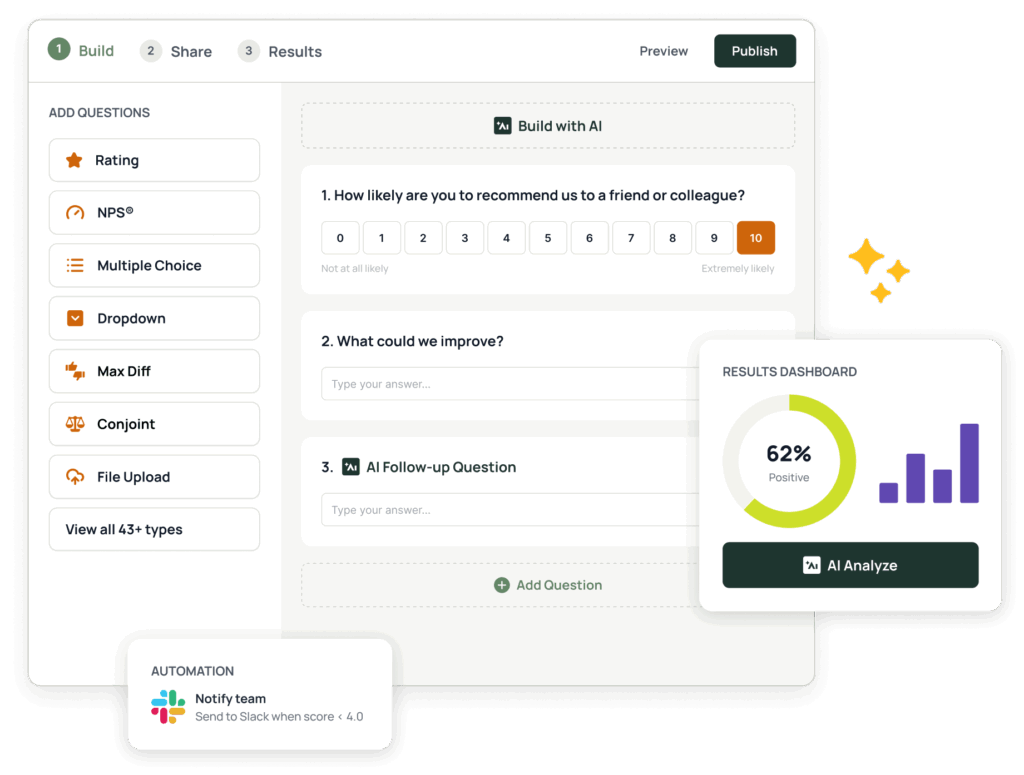
Voice of Customer surveys can strengthen a VoC program when they produce reliable, actionable feedback. Poor survey design can introduce bias, increase respondent effort, and produce data that leads teams toward the wrong conclusions.
For transactional feedback, event triggered surveys are usually more relevant than calendar-based surveys. Post-purchase, post-support, post-onboarding, post-renewal. Relationship surveys can run on a fixed cadence, since their value is the consistent trend line. Same-day for transactional feedback; the memory decays fast.
Survey design best practices.
- Ask fewer questions than you want to. Every added question increases respondent effort and can affect completion.
- Pair every score question with one open-text follow-up. The score is the headline; the comment is the story.
- One idea per question. Double-barreled questions produce unusable answers.
- Avoid leading language. “How much did you enjoy our fast delivery?” is not a question, it’s a compliment fishing for agreement.
- Randomize answer order where order effects might bias results.
- Design mobile-first and test on a phone so the survey works well across devices. Keep question wording identical across cycles. Rewording a question resets your trend line.
Voice of Customer Examples
VoC looks different depending on who’s asking and what they need to decide. Here’s what a program produces across departments, industries, and journey stages.
Voice of Customer Examples by Team
| Team | What They Ask | What Voc Data Produces |
|---|---|---|
|
Product |
Which features matter, and what’s missing? |
Customer evidence to inform roadmap priorities, plus previously unidentified demand signals |
|
Support |
Are we resolving issues well, and where are agents struggling? |
Coaching grounded in customer feedback, plus earlier visibility into recurring issues and escalation risks |
|
Marketing |
How are we perceived, and does the message land? |
Segment insight, messaging validation, and social proof for acquisition |
|
Customer Success |
Which accounts are at risk? |
Potential churn signals and prioritized retention outreach |
|
Operations |
Where do our processes fail customers |
Specific, fixable friction with location or process-level detail |
|
Executive team |
Is the experience improving, and does it show up in results? |
A consistent view of customer health alongside revenue and retention indicators |
VoC Examples by Journey Stage
- Pre-purchase: Review sentiment and win/loss feedback explain why prospects choose you or don’t.
- Onboarding: Effort scores around onboarding and first value can reveal friction that may put early retention at risk.
- In-product: In-app prompts catch frustration while the customer is still in the moment.
- Post-support: CSAT tied to agent, channel, and issue type turns satisfaction data into coaching.
- Renewal: Relationship surveys and sentiment trends flag risk while there’s time to act.
VoC Examples by Industry
- Software: VoC informs the roadmap and helps teams evaluate evolving customer needs in mature segments.
- Financial services: In-app feedback during platform migrations protects trust at the riskiest moment.
- Multi-location retail and restaurants: Location-level reviews and surveys make brand consistency measurable.
- Healthcare and senior living: Feedback from patients, residents, and families can surface patterns in service experiences, communication and operational processes.
- Logistics and B2B services: Ad hoc research and account-level VoC can inform product strategy and prove ROI.
Voice of Customer Survey Questions
Effective VoC surveys combine quantitative measures with diagnostic follow-up questions that help explain the score. Here are Voice of Customer survey questions to use as a starting point:
Loyalty and advocacy questions:
- How likely are you to recommend us to a friend or colleague? (0–10)
- What’s the main reason for your score?
- How satisfied were you with your recent [interaction]?
- How much effort did it take to get your issue resolved?
- What would have made that easier?
Needs and expectations questions:
- What were you trying to accomplish when you contacted us?
- To what extent did we meet your expectations? What could we have done better?
- What’s the one thing we could change that would matter most to you?
Product and roadmap questions:
- Which part of the product do you rely on most?
- What’s missing that would make your work easier?
- What capability would make this product more useful to you?
Churn risk and retention questions:
- How likely are you to continue using us over the next 12 months?
- Have you considered alternatives in the last six months? What prompted that?
That last question is uncomfortable and worth asking. Honest answers can surface reasons customers are considering alternatives and give teams clearer retention priorities.
How to Improve Voice of Customer Surveys
Increasing response rates. Shorten the survey. Trigger it at the right moment. Match the channel to the customer. Explain what you’ll do with the answers. Most importantly, close the loop from the last cycle — response rates climb when customers have already seen their feedback change something.
Avoiding survey fatigue. Set global frequency caps, suppress recently surveyed customers, retire questions you’re not acting on, and vary length. If your response rate is falling, that’s usually fatigue talking, not indifference.
Collecting actionable feedback. The test for every question: if 40% of customers answer this a particular way, do we know what to do next? If not, the question needs rewriting or removing.

How to Analyze Voice of Customer Data
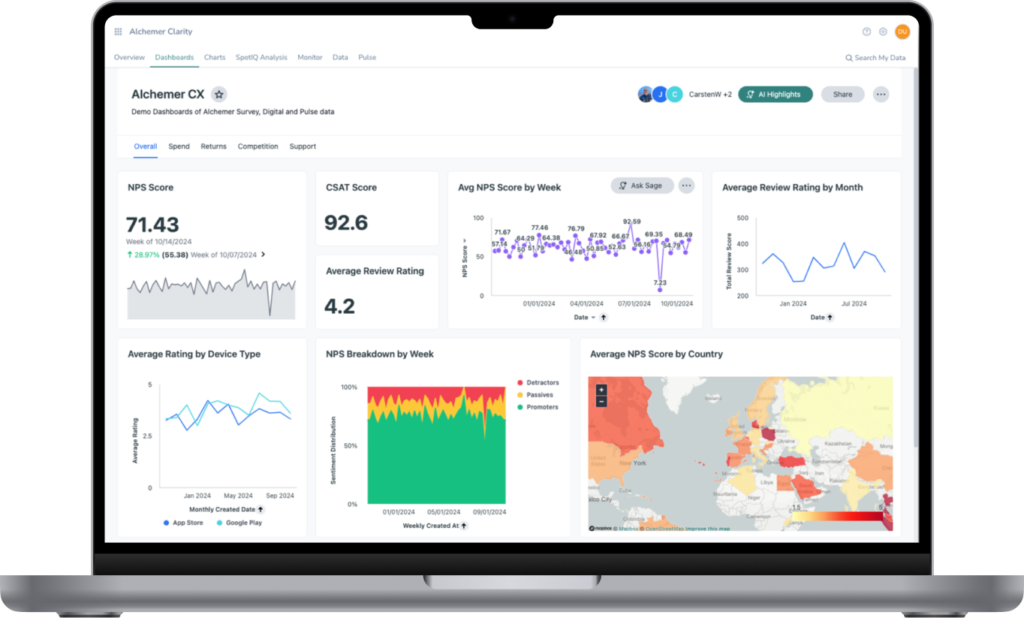
Voice of Customer analysis is the process of turning raw customer feedback into insight the business can act on. It combines sentiment analysis, trend analysis, text analytics, AI-powered insights, dashboards, reporting, segmentation, and action planning to identify what customers care about, how those patterns are changing, and where the organization may need to investigate or act.
Collecting feedback is only the first step. Analysis becomes especially challenging when a VoC program includes large volumes of unstructured feedback that cannot be reviewed efficiently by hand.
Sentiment analysis. Aspect-based models score sentiment in context, so a comment praising the product and criticizing support registers as two distinct signals rather than one muddled average.
Trend analysis. Direction matters more than any single reading. Tracking volume and sentiment by theme over time tells you what’s improving, declining, and newly emerging.
Text analytics. Automatic theme detection across open-text, reviews, and support transcripts. This is the capability that makes open text usable. A global automotive research firm compressed a six-month analysis of more than 300,000 open-text responses into hours.
AI-powered insights. Purpose-built AI surfaces patterns that may be difficult to identify through predefined categories or manual review alone. Malwarebytes had been coding feedback into the seven customer segments they assumed they had. AI found 15, which reshaped marketing strategy and the product roadmap. Washburn & McGoldrick cut analysis time by more than 50% while removing coder bias.
Dashboards. Role-based views that blend survey scores, review sentiment, and open-text themes, with the ability to drill from a trend line down to an individual response. Aggregate numbers persuade nobody; the specific comment behind them does.
Reporting. A consistent, stakeholder-ready summary on a predictable cadence. This is the artifact that closes the gap between “we measured it” and “leadership acted on it.”
Segmentation. Cut by segment, tenure, product, region, and channel. A stable overall score routinely hides a 20-point gap between two customer groups, and the gap is the insight.
One principle worth holding onto: automation with a human in the loop. AI should do the reading and the ranking. People should still make the call on what to do, with approvals and controls where the stakes are high.
How the VoC platform market breaks down
The 2026 Gartner® Magic Quadrant™ for Voice of the Customer Platforms places vendors in four quadrants: Leaders, Challengers, Visionaries, and Niche Players. Alchemer was positioned as a Challenger for the second consecutive year, and has been recognized in the report five times.
| Category | Alchemer | Medallia | Qualtrics | QuestionPro | SurveyMonkey |
|---|---|---|---|---|---|
|
Core Feedback Capabilities |
Collect and connect omnichannel feedback including surveys, digital channels, listings, and ratings & reviews without heavy setup. |
Full CX suite with advanced analytics and broad reach, but high complexity. |
Enterprise-scale XM across CX/EX, high complexity. |
Mid-market survey and CX features for quick wins. |
Basic surveys with limited logic and scale. |
|
Analytics & AI |
Customizable dashboards, role-based reporting, AI text analysis, and AI conversational assistants. |
Powerful analytics that risk overwhelming non-technical users. |
Deep analytics with high implementation costs and requirements. |
Basic analytics with limited depth. |
Slower, limited analytics. |
|
Ease of use |
Fast, flexible setup, fewer IT dependencies, and flexibility for both simple and sophisticated programs. Fast time to value. |
Steep learning curve and manual workflows. |
Heavy implementation, often requires third parties. |
Easier interface but faces admin limitations |
Simple for beginners, lacks enterprise readiness. |
|
Support & Service |
94 NPS with accessible, hands-on success teams who stay with you post-launch. |
Restricted support hours; extra charges for enhanced support. |
Slow response times; most support tiers require additional cost. |
Limited collaboration support. |
Basic support without CX program guidance. |
|
Integrations |
Unlimited integrations at all tiers with fast deployment. |
Solid integrations but with complex setup. |
Fewer out-of-box integrations; added cost and long timelines. |
Limited integration options. |
BI integrations for top tier only. |
Alchemer’s differentiator centers on operational flexibility rather than analytical breadth. Enterprise-grade capability, faster implementation, full data ownership, and a program you can change yourself when the business question changes. Ryder chose it for exactly that reason after finding other enterprise platforms required specialized developers and significant implementation investment.
Why Organizations Choose Alchemer for Voice of Customer
Organizations use Alchemer for core Voice of Customer needs. Here’s how the platform supports each one. Underneath all of it: SOC 2 Type II certification, GDPR compliance, HIPAA-ready configurations, and implementation measured in days. Alchemer holds a 94 NPS® and serves more than 11,000 customers across 100+ countries.
Capture Customer Feedback Across Multiple Channels
Surveys by email, web, SMS, QR, and kiosk. In-app and on-site prompts through Alchemer Digital Experience, which reaches more than 500 million people monthly across its customers' digital footprint. Reviews and location-level signals across Google, Yelp, Apple Maps, app stores, and 200+ industry sites. Direct and indirect feedback in one system rather than stitched across vendors.
Analyze Customer Feedback at Scale
Alchemer Pulse applies purpose-built AI to open text, assigning sentiment in context and grouping comments into clear themes, then tracking volume and sentiment shifts over time.
Share Insights Across Team
Role-based dashboards give each function the view that matches its decisions, with drill-down from aggregate trend to individual customer response. Malwarebytes' cross-functional teams work from shared Alchemer dashboards, helping the organization use VoC insights across teams rather than limiting them to reporting.
Integrate with Your Systems and Automate Feedback
Teams can configure detractor scores, low CSAT, and negative reviews trigger alerts, assign owners, and open cases automatically. Feedback routes into Salesforce, HubSpot, Zendesk, Slack, Microsoft Teams, and 400+ other systems, so closed-loop follow-up happens in the tools teams already use.
Voice of Customer Success Stories
Three programs at different stages of maturity, in three very different businesses. Each moved from scattered feedback to a VoC program that changes decisions.
- Choose a story below
Ryder
Ryder System, a Fortune 500 transportation and logistics company managing one of North America’s largest fleets, had a VoC program in pieces: multiple tools, multiple partners, and expensive agency research the team didn’t own the data from.

Senior Director of Customer Insights John Trenholm was tasked with building a scalable, cost-effective listening program that could prove ROI to executive leadership. Other enterprise platforms required specialized developers and heavy implementation investment. With Alchemer, Ryder brought research in-house, eliminated agency fees, purchased samples directly, and retained full ownership of its data. Survey build and collection time dropped from weeks to days. The program now spans ad hoc market research, multi-location insights across hundreds of sites, and employee listening. Ryder has since begun offering Alchemer-based VoC capability to its own logistics customers as a value-added service.
Flash
The Buffalo Sabres don’t just sell tickets — they sell a gameday experience that runs from the moment fans arrive downtown to the final horn. Before Alchemer, the team collected fan feedback, but not at the depth, speed, or scale they needed to act on it. They built “Gameday Pulse,” a survey sent after every home game that benchmarks four KPIs — NPS, CSAT, purchase intent, and word of mouth — alongside diagnostics like concessions, atmosphere, and arena entry and exit.

Using Alchemer’s advanced logic and branching, a single survey serves different questions to different fan segments, and results flow straight into the Sabres’ data warehouse and analytics tools for real-time visibility. The payoff: fan survey participation doubled year over year, the team analyzed 41,000+ open-ended responses, and CSAT, NPS, and arena atmosphere ratings all posted double-digit gains — driving measurable revenue growth. When fans saw the team act on their feedback, satisfaction climbed month after month.
Key Outcome: Doubled survey participation, improved customer satisfaction metrics, and generated measurable revenue impact through continuous fan feedback.
Malwarebytes
In cybersecurity, growth is hard-won and customer trust is everything. Malwarebytes had outgrown SurveyMonkey and needed a survey platform that could scale its NPS and satisfaction program across the business — with the dashboards and reporting to make insights impossible to ignore.

With Alchemer, the company now runs tens of thousands of consumer surveys and hundreds of business NPS surveys each month, with low scores routed automatically to the right team and results synced in real time to Salesforce and Zendesk. Anyone who scores a 7 or below gets contacted within 24 hours. Layering in Alchemer Pulse to analyze open-text survey responses, the team uncovered 15 customer segments where they’d assumed seven, informed four new product launches, and lifted their sentiment score by 60+ points — all contributing to double-digit revenue growth in a mature market.
Key Outcome: Scaled customer feedback programs, improved sentiment by 60+ points, and supported double-digit revenue growth through data-driven customer experience improvements.








What Customers Are Saying About Alchemer's VoC Software


See how VoC and Customer Insights teams use Alchemer to collect feedback across every channel, analyze it at scale, close the loop automatically, and prove the program’s value to leadership.
Related Voice of Customer Resources

Alchemer for Customer Engagement
Drive customer acquisition, adoption and retention—across your entire business...

Survey Software: Tools, Platforms, and Buyer's Guide
Smart thinking: you’ve decided to use a survey to gather feedback on your company’s customer experience (CX)...

Alchemer Positioned As A Challenger In The 2026 Gartner® Magic Quadrant™ For Voice Of The Customer Platforms
Included for the fifth consecutive time for its Ability to Execute and Completeness of Vision...
Voice of Customer (VoC) is the structured process of capturing what customers tell you about their needs, expectations, and experiences, then turning that input into insight the organization acts on. It combines direct feedback like surveys and interviews with indirect feedback like reviews, social posts, and support conversations.
Customer feedback is the raw material — an individual survey response, review, or support conversation. Voice of Customer is the program that collects, analyzes, and acts on that material systematically, with defined touchpoints, owners, and reporting. Feedback is the input; VoC is the system.
VoC is the listening discipline. Customer experience management is the broader practice of designing and improving the experience across the journey. VoC supplies the evidence; CX management is what you do with it.
A VoC program is an ongoing, cross-functional discipline built from six components: feedback collection at defined touchpoints, always-on customer listening, cross-functional ownership, closed-loop feedback, continuous improvement, and executive reporting.
Define the business question the program will answer, map and select the customer touchpoints worth measuring, name owners for the program and each theme, collect feedback consistently with automated triggers, build closed-loop routing before launch, and review themes on a set cadence so priority changes are implemented and measured over time.
A Voice of Customer survey collects structured feedback about a customer’s needs, expectations, or experience at a specific moment. It typically pairs a metric anchor like NPS®, CSAT, or CES with an open-text follow-up that provides context for the score.
Pair a metric question with diagnostic follow-up. Useful examples include “What’s the main reason for your score?”, “What were you trying to accomplish?”, “What’s the one thing we could change that would matter most to you?”, and “Have you considered alternatives in the last six months?” Keep the survey short and ask one idea per question.
VoC analysis turns raw feedback into insight using sentiment analysis, trend analysis, text analytics, AI-powered theme detection, dashboards, segmentation, and action planning. Unstructured open-text feedback can be especially challenging to analyze at scale, which is where AI-assisted analysis can be particularly useful.
Use AI-powered text analytics to assign sentiment in context and group comments into themes automatically, then rank themes by volume, sentiment severity, and business exposure. Manual coding doesn’t scale past a few hundred responses and introduces coder bias. Washburn & McGoldrick cut analysis time by more than 50% by automating theme categorization.
Ways to improve customer retention include identifying friction across the journey, reviewing CES and other effort signals, following up on significant negative feedback, closing the feedback loop, combining sentiment with behavioral data to identify potential risk patterns, and giving frontline teams enough visibility to act before renewal or cancellation.
Closed-loop feedback is a process where customer feedback automatically triggers a follow-up action. For example, a detractor response routes to an owner for outreach, a low CSAT score opens a case, or a negative review assigns to a location manager. Closing the loop connects feedback with follow-up and gives teams an opportunity to address customer concerns.
The program outputs to business outcomes: retention and churn in surveyed segments versus unsurveyed, revenue from changes the program informed, cost avoided by catching issues early, and research costs saved by running studies in-house. Ryder proves VoC ROI to executive leadership using Alchemer, in part by eliminating agency research fees.
A named owner, usually in Customer Insights, CX, or Customer Success, supported by a cross-functional working group spanning product, support, marketing, and operations. Programs owned by one team in isolation produce insights other teams feel no obligation to act on.
Alchemer was positioned as a Challenger in the 2026 Gartner® Magic Quadrant™ for Voice of the Customer Platforms, its second consecutive year in that quadrant. It delivers enterprise-grade capability — omnichannel feedback, AI open-text analysis, 400+ integrations, and enterprise governance — with faster implementation, full data ownership, and lower total cost than Qualtrics or Medallia, and significantly more program depth than SurveyMonkey or QuestionPro.
es. Alchemer is SOC 2 Type II certified and supports GDPR, with options for data residency, retention controls, and HIPAA-ready configurations. Customer data never trains third-party AI models.
Most teams launch initial collection within days using templates and pre-built integrations. Building a mature program — defined touchpoints, closed-loop routing, cross-functional ownership, executive reporting — typically takes a quarter or two of iteration. Ryder cut survey build and collection time from weeks to days.