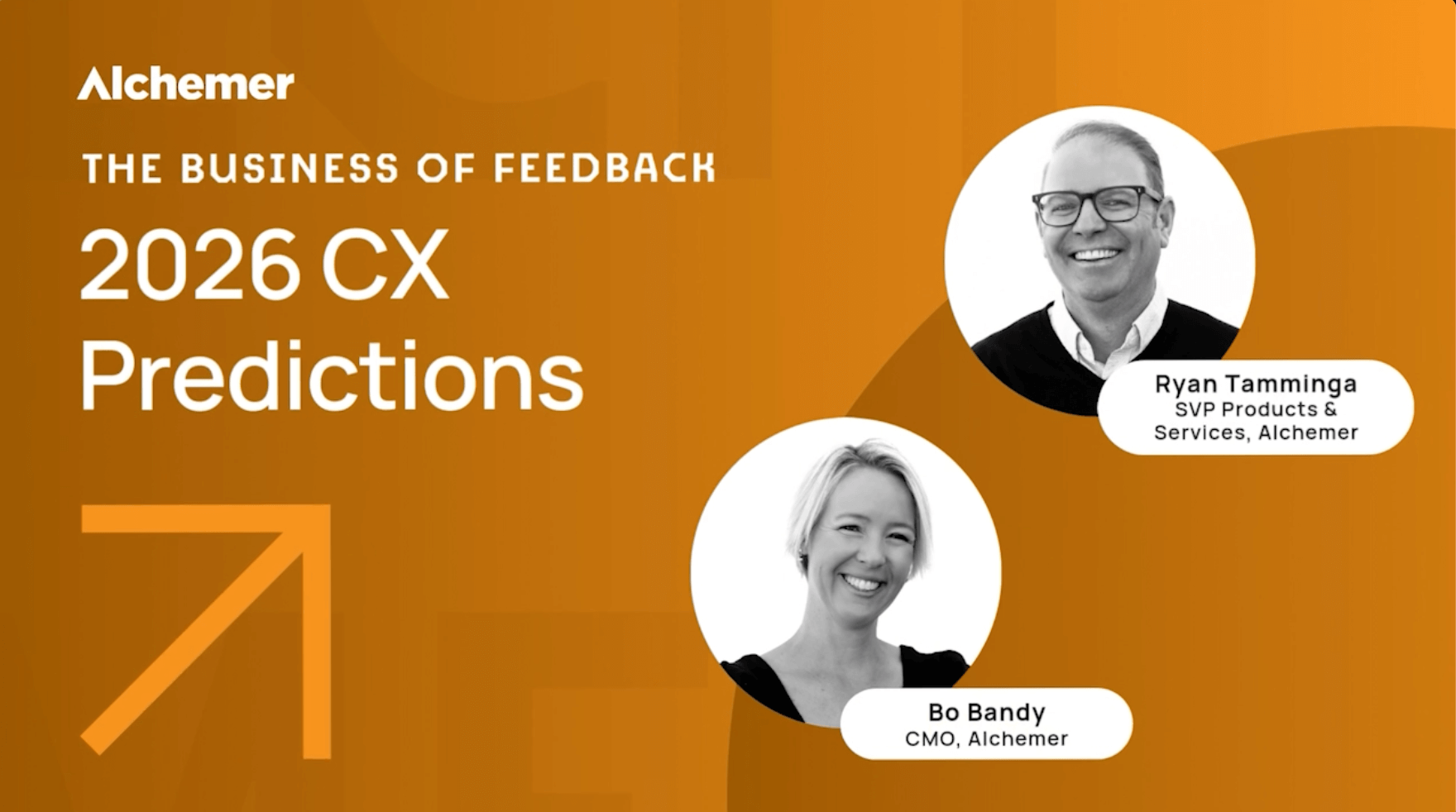
Customer experience is evolving faster than ever – and the future of customer experience will demand smarter, more connected, and AI-driven programs.
In Episode 6 of The Business of Feedback, Alchemer CMO, Bo Bandy, chats with Ryan Tamminga, our SVP of Product and Services, about what’s next for CX. They dig into the forces reshaping feedback programs, the impact of AI, and how teams can stay ahead as customer expectations keep climbing.
Their take? CX in 2026 will be always-on, AI-assisted, and everywhere.
Here’s a quick look at three predictions from their conversation.
1. Listening everywhere is the new CX baseline
Customer experience in 2026 looks nothing like it did a few years ago.
As Ryan explains, the post-COVID reset has helped organizations clarify where they want to go next. What he’s hearing consistently across Alchemer’s customer base is a growing need to listen more broadly.
“What we’re hearing all over our customer base is we need to listen to more customers and more of the places that they’re talking about our company, brand, services, and products.”
— Ryan Tamminga, SVP of Product and Services, Alchemer
For years, surveys have been the backbone of CX programs. They provided structure, intent, and clarity. That foundation still matters and is not going away.
What has changed is everything around them.
With digital engagement surging, customers are sharing feedback on their own terms—wherever and whenever they feel like it. CX isn’t tied to one channel or a single touchpoint anymore. It’s happening all the time.
And the teams that embrace this shift? They’re the ones who will truly understand what matters most to their customers—and be ready to act on it.
CX Trend 2026: Leading brands will treat omni-channel listening as a default, not a differentiator.
2. Direct and indirect feedback must work together
Bo and Ryan unpack the difference between direct and indirect feedback—and why you can’t afford to ignore either one.
“Direct is really focused on that survey concept or first-party data where somebody’s telling you something directly. Indirect refers to all of the places where people are talking about you, but you may not actually know.”
— Ryan Tamminga, SVP of Product and Services, Alchemer
Indirect feedback, on the other hand, shows up everywhere else. Think TripAdvisor, Yelp, app store reviews, and even social media. It’s feedback you didn’t ask for, but it’s out there shaping perception all the same.
The opportunity in 2026 isn’t to pick one. It’s to connect the dots between them.
When teams bring these sources together, they uncover themes that stretch beyond individual touchpoints. They gain insights not just from current customers—but from prospects, passive audiences, and even the ones who chose a competitor.
The message is clear: feedback is happening with or without you. The smartest brands are choosing to listen to all of it.
CX Trend 2026: Feedback programs that integrate direct and indirect feedback will outperform siloed strategies.
3. AI in customer experience won’t replace CX teams—but it will supercharge them
AI isn’t replacing CX professionals – it’s enhancing their ability to understand and act faster. In this episode, Ryan explains how large language models (LLMs) are transforming the feedback-to-action cycle.
“Instead of having to dig through the data on your way up to an answer, it’s actually going to help expose more of the answers right up front and help you dig in from there.”
— Ryan Tamminga, SVP of Product and Services, Alchemer
The truth is, CX teams are flooded with feedback. It’s coming in from every channel, in every format, and at all hours. Manually sorting through it means most teams only scratch the surface.
But with the right AI, teams can leapfrog the usual crawl-walk-run maturity curve. Less time chasing insights. More time acting on them. That’s how AI becomes a CX accelerator, not a replacement.
CX Trend 2026: AI in customer experience will shift from experimental to essential.
What else is shaping the future of customer experience?
In addition to AI and omni-channel feedback, Bo and Ryan discuss:
- Vendor consolidation and its impact on the CX tech stack
- Budget pressure driving platform reevaluation
- The merging of employee and customer experience (EX + CX)
Curious what else 2026 has in store?
Watch The Business of Feedback: Episode 6 – 2026 CX Predictions
Key takeaways for CX Leaders in 2026
To stay competitive, CX programs must evolve from static systems into agile, intelligence drive operations. Here’s what that means:
- Embrace both direct and indirect feedback
- Adopt AI to scale insight delivery
- Capture signals across all digital and physical channels
- Evaluate CX software based on integration, speed, and adaptability
The future of customer experience starts now
The best CX programs in 2026 won’t just measure—they’ll predict, influence, and act in real time.
If your current feedback system isn’t built for what’s next, now is the time to evolve. Alchemer helps customer-centric teams listen deeper, respond faster, and make feedback actionable—everywhere it happens.