
Customers don’t discover brands by accident anymore. They search. They compare. They read reviews. They scan social posts. They look at location pages. And long before they ever walk into a store or book an appointment, they’ve already formed an opinion. That opinion—fair or not—is your brand perception.
For multi-location organizations, brand perception is shaped across hundreds or thousands of local touchpoints. One poor experience in a single branch can show up in reviews. One inaccurate listing can erode trust. One unresolved complaint can influence dozens of future buyers.
Measuring and improving brand perception at scale requires more than monitoring reviews. It requires structured listening, actionable insights, and operational alignment.
Enter Alchemer: the platform that not only helps you capture customer feedback but also enables you to connects all signals that shape how your brand is perceived — at every location, across every channel.
The 5 A’s of brand perception
Measuring perception is most effective when viewed as a journey. Alchemer helps you at five critical stages:
Awareness
Are customers finding you?
Accurate listings, optimized local pages, and strong search presence influence first impressions. Listings management tools help ensure customers encounter consistent, trustworthy information, at scale across locations.
Associations
What qualities do customers connect to your brand?
AI-powered sentiment analysis can reveal whether customers associate your brand with:
- Speed
- Friendliness
- Reliability
- Value
- Quality
If your marketing promises “premium service,” but review sentiment clusters around “long wait times,” there’s a perception gap.
Attitude
How do customers feel about you?
Survey results combined with sentiment trends in review data provide a measurable view of emotional response. By tying survey feedback to review data, brands can see whether attitude shifts reflect operational changes.
Attachment
Are customers loyal?
Attachment shows in repeat positive mentions, strong NPS scores, and consistent location-level performance. With reputation management tools, brands can identify which locations foster the strongest loyalty—and replicate those practices elsewhere.
Action
Do customers follow through?
Perception ultimately drives behavior: bookings, visits, referrals. While many organizations track conversion metrics separately, aligning them with feedback and sentiment data helps clarify whether perception is accelerating—or limiting—growth.
The three pillars of measuring brand perception
To manage perception, you first need visibility. For multi-location brands, that visibility requires customer feedback and intelligence. At a high-level, customer feedback and intelligence can be broken down into three categories:
1. Direct feedback (What customers tell you directly)
Surveys remain one of the most reliable ways to measure:
- Brand trust
- Satisfaction (CSAT)
- Net Promoter Score (NPS)
- Perceived value
- Emotional drivers
Alchemer’s feedback and Voice of Customer (VoC) capabilities allow organizations to collect structured input across digital, in-store, SMS, email, and web channels.
But collecting responses isn’t enough.
With Alchemer, feedback can be segmented by:
- Location
- Region
- Franchise group
- Service line
- Customer segment
This is critical for multi-location brands. A national average score often hides local issues. Alchemer helps brands see where perception breaks down—and why.
2. Indirect feedback (What customers say publicly)
Customers don’t just respond to surveys. They post reviews. They comment on social media. They leave open-text feedback.
That’s where advanced sentiment analysis becomes essential.
Through Alchemer’s AI-powered analytics, brands can:
- Identify emerging reputation risks
- Detect recurring complaints across locations
- Surface operational themes (e.g., staffing, cleanliness, wait times)
- Track sentiment shifts over time
This moves perception measurement beyond star ratings.
Instead of asking, “Why did our rating drop?”
You can answer, “Which operational issues drove the change, and where?”
That level of insight is especially valuable for operations leaders and franchise managers who need to act quickly.
3. Competitive context
Brand perception doesn’t exist in a vacuum. Customers compare you to competitors in the same market.
Alchemer’s competitive intelligence and benchmarking capabilities allow brands to:
- Compare sentiment and ratings against local competitors
- Identify differentiators customers mention
- Track keyword themes across competitors
- Spot reputation gaps by geography
For multi-location businesses, this local context matters. A brand may perform well nationally but struggle in specific metro areas. That’s where competitive perception can influence foot traffic and conversion.
Why brands struggle to manage brand perception across locations
In practice, perception challenges often stem from operational complexity:
- Inconsistent review response quality across locations
- Delayed resolution of complaints
- Listing inaccuracies that erode trust
- Limited visibility into franchise performance
- Disconnected survey and review data
Many platforms focus on automation—auto-responses, templated replies, bulk posting. Automation has value. But automation without insight doesn’t improve perception.
Alchemer’s approach centers on turning customer signals into operational clarity.
For example:
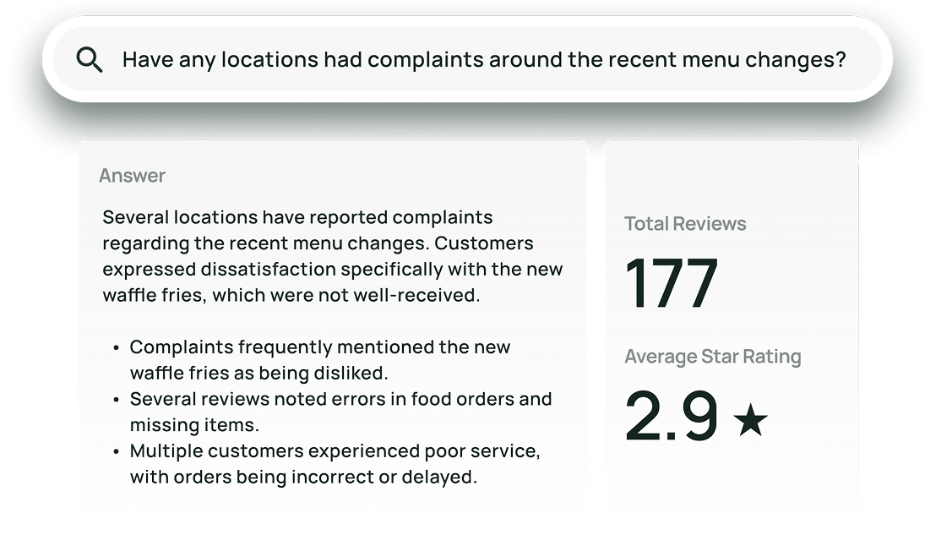
- AI summaries highlight systemic issues across regions
- Workflow tools ensure feedback routes to the right teams
- Location-level dashboards enable frontline accountability
- Competitive benchmarking adds external perspective
This combination supports governance without sacrificing local flexibility.
Turn brand perception into a strategic advantage
For brands, choosing reputation management solution usually boils down to four critical questions:
- Scalability: Can this handle hundreds or thousands of locations?
- Usability: Will local operators and franchisees actually adopt it?
- Utility: Are these actionable insights or just more “dashboard noise”?
- Resolution: Does this help us fix systemic issues or just track them?
Alchemer addresses those concerns by combining:
| Feature | Strategic Impact |
| Direct Feedback Engines | Deploy high-conversion surveys, SMS, and in-app prompts to hear from customers in the moment. |
| Indirect Signal Tracking | Automatically aggregate third-party reviews, social mentions, and digital breadcrumbs to see the “unspoken” brand truth. |
| Enterprise Governance | Maintain brand integrity across thousands of users with granular permissions and SSO. |
| Location Benchmarking | Identify top-tier performers and provide data-backed coaching for underperforming sites. |
| AI-Driven Intelligence | Use NLP to move beyond “positive/negative” sentiment to understand the root cause of rating shifts. |
| Structured Workflows | Bridge the gap between data and deed with closed-loop tasks for distributed teams. |
Ready to do more with feedback ? Request a demo to see Alchemer’s brand and reputation management features in action.