
Every customer interaction — from a Google review to a five-star mention on social — tells a story. But most brands still treat customer feedback as a rear-view mirror, not a strategic growth engine.
In our recent webinar, From Reviews to Revenue, we demonstrate how feedback can drive operational change and measurable impact — not just higher NPS scores.
In this blog, we recap some of the key themes from that webinar. You can use use this link to watch the full conversation.
How to tie sentiment to ROI
When it comes feedback analysis, sentiment isn’t just about “positive vs. negative.” It’s the layer of business intelligence that connects customer feedback directly to operational trends and financial outcomes.
Here are a fewy ways teams can make that link:
1. Tie sentiment to customer behavior
Customers vote with their wallets, and sentiment is often the earliest signal that behavior is about to change. When feedback shifts, revenue metrics usually follow.
Some examples:
- Longer checkout wait times → increased abandonment.
- Service complaints → fewer repeat purchases.
- Pricing confusion → lower basket sizes.
AI-driven sentiment analysis helps you quantify how frequently specific issues show up and where, so you can estimate the impact on key revenue levers — conversion, retention, and spend.
2. Track changes over time
Sentiment only becomes meaningful when it’s tracked consistently. Point-in-time insights are helpful, but trend analysis is what reveals whether fixes are working or problems are compounding.
Teams can monitor:
- Sentiment before vs. after training.
- Performance across field teams.
- Local changes tied to specific fixes (e.g., staffing changes).
3. Assign sentiment insights to business KPIs
Sentiment becomes actionable when it’s tied to the KPIs teams already track — revenue, conversion, repeat visits, and operational efficiency. For example:
- Automotive retailer: Rising complaints about service wait times align with lower service bay utilization or missed revenue targets. The issue just a CX issue — it’s impacting throughput and lost revenue.
- Restaurant or QSR: Increasing mentions of slow checkout or order errors show up alongside lower peak-hour sales, pointing to staffing or process bottlenecks.
- Coffee chain or retail brand: Confusion around pricing or promotions correlates with lower average ticket size, signaling friction at the point of purchase.
In each case, sentiment connects directly to performance, giving teams a clear issue to fix and a data-backed reason to prioritize action where experience and revenue intersect.
Focus on drivers, not just the symptoms
Many brands take a surface-level approach: react to every negative review, respond quickly, hope sentiment improves. But that leads to firefighting instead of strategic change.
The smarter approach: focus on drivers, not symptoms.
Alchemer’s Pulse Ai reputation management tools analyze every piece of customer feedback — reviews, surveys, even images within reviews — and surface the topics that matter most to your business. Pulse Ai goes beyond traditional keyword tagging with AI-driven sentiment and topic inference that understands context and patterns at scale.
Teams can:
- Identify the top trending issues impacting customer experience.
- Compare how topics vary by location or region.
- Detect emerging issues before they go viral with built-in risk monitoring.
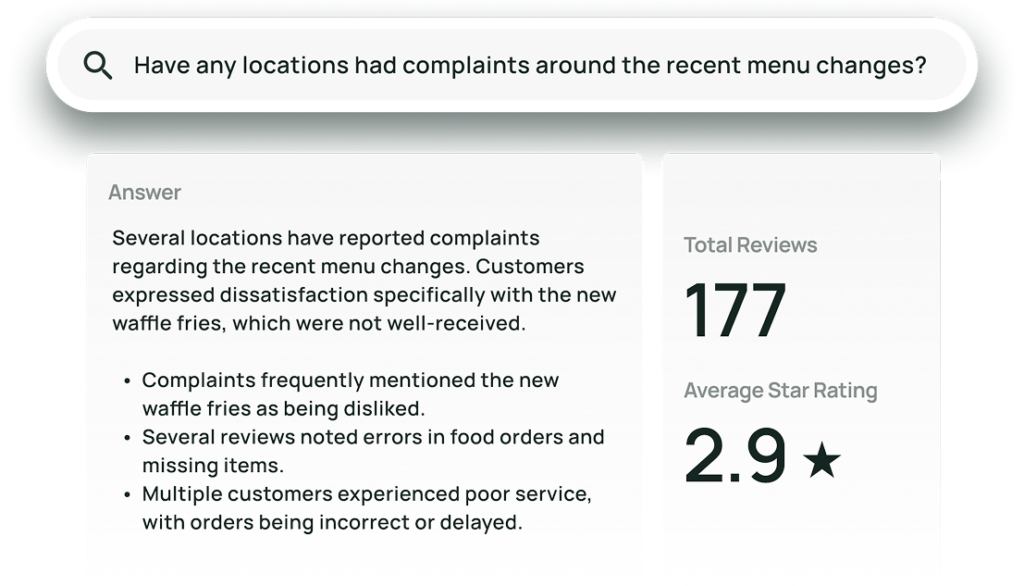
Instead of “look at this 3-star review,” leaders can ask:
“What are customers talking about most in Texas locations this week?”
“Where is checkout satisfaction dropping fastest?”
“Which locations are driving negative service sentiment?”
…and get answers in seconds.
Ask the right questions—and close the loop
Generic dashboards don’t drive change. They summarize what already happened, but they don’t tell managers what to fix next.
What actually moves the business are precise, operational questions—the kind that connect customer feedback directly to onsite decisions. That’s the shift Pulse Ai enables.
Instead of scanning charts or reacting to individual reviews, managers can ask plain-language questions and get immediate, actionable insight, such as:
- What are the longest wait times in my Texas locations?
- Which stores are seeing the biggest drop in positive service sentiment this month?
- Where are safety or brand-risk issues emerging right now?
- What product complaints are most common across the Southeast?
The answers to these questions provide operational intelligence triggers. Each one points directly to a fix—staffing, training, pricing, layout, or process—that can improve experience and protect revenue.
Because Pulse Ai analyzes feedback thematically (not through basic keyword matching), teams can query sentiment across reviews, social posts, and other unstructured data without manually reading thousands of comments. Patterns surface instantly, and insights are grounded in what customers actually experience, not assumptions.
But insight alone isn’t enough. To turn feedback into revenue, teams need a closed-loop operational workflow. One that ensures issues don’t stop at discovery.
1. Detect
Pulse Ai continuously ingests customer feedback across channels and automatically surfaces:
- The most common and impactful customer concerns
- Risky reviews or content that could escalate
- Emerging trends at the location, regional, or brand level
This matters because manually monitoring reviews almost always leads to blind spots. Issues can quietly build across locations, go unnoticed, and eventually surface as reputational damage or a negative news moment. Real-time detection allows teams to catch risks early and act before they snowball.
Detection isn’t just about preventing problems, though. Pulse Ai also flags emerging positive sentiment — uncovering what customers love most. Those insights can reveal opportunities to double down on high-performing products, experiences, or locations and turn momentum into measurable revenue growth.
2. Route
Once issues are detected, they don’t sit in a dashboard. Insights are routed to the teams that can act:
- Regional managers see location-specific breakdowns
- Training leaders are alerted to service gaps
- Risk teams are notified of potential brand or safety issues
Alerts can be automated, ensuring the right people get the right insight without delay.
3. Resolve
This is where revenue impact shows up. Teams can take targeted action by:
- Fixing staffing bottlenecks that cause long wait times
- Standardizing service protocols where sentiment is slipping
- Adjusting pricing visibility, product placement, or in-store processes
Execution is now tied directly to validated customer feedback patterns, not intuition or anecdotes.
4. Monitor
After changes are made, Pulse Ai continues to watch:
- Did sentiment improve after the fix?
- Are complaints decreasing at affected locations?
- Is the issue staying resolved—or starting to resurface elsewhere?
This allows teams to quantify success, test fixes at a regional level before rolling them out brand-wide, and catch regressions early, before they impact revenue again.
Together, this cadence transforms customer feedback into an asset that helps managers move faster, act with confidence, and continuously improve onsite experience where it matters most.
Why this matters — and why now
Reviews and feedback are real-time signals of business health. Consumers read reviews before they buy, and feedback influences:
- Local search visibility
- Consumer trust and conversion behavior
Alchemer helps teams move beyond reactive reputation management to proactive customer intelligence — and that’s what the best brands in our “From Reviews to Revenue” webinar are already doing.
If you want to:
- Understand what customers are really saying
- Tie sentiment to business performance
- Turn feedback into operational results
…then you’re exactly in the right moment to learn from this series.
To learn more and see Alchemer’s AI features in action, watch the “Reviews to Revenue” webinar, here!