NPS Survey Software That Turns Customer Feedback Into Action
NPS survey software is a platform that helps organizations create Net Promoter Score® (NPS®) surveys, send them across channels, calculate and track scores, analyze the feedback behind them, and route responses to the teams who can act. Alchemer’s NPS survey software connects the score to the reason, and the reason to a next step.

What Is NPS Survey Software?
NPS survey software is a platform that helps organizations measure customer loyalty with Net Promoter Score surveys. It lets teams create NPS surveys, distribute them across channels, calculate scores, segment promoters, passives, and detractors, analyze open-ended comments, track results over time, and trigger follow-up actions that close the feedback loop.
That definition has two halves. The first is measurement: build the survey, send it, calculate the score. Every NPS tool does this. The second half is where software earns its keep: understanding why customers scored you the way they did, and making sure someone acts on it.
A complete NPS survey platform helps you:
- Create NPS surveys with the standard 0–10 question and score-based follow-ups
- Distribute surveys across email, SMS, web, and in-app channels
- Calculate your Net Promoter Score automatically as responses arrive
- Identify promoters, passives, and detractors
- Analyze open-ended comments for sentiment and themes
- Track NPS over time, by segment, location, product, or account
- Segment results to find where loyalty is strong and where it’s slipping
- Trigger alerts and follow-up actions based on score or comment
- Close the loop by making sure every response reaches an owner
The goal is to understand why customers stay, leave, or recommend you, then make improvements because of what you learn.
How Does an NPS Survey Work?
An NPS survey asks one question: “How likely are you to recommend us to a friend or colleague?” Customers answer on a 0–10 scale. Those who choose 9 or 10 are promoters, 7 or 8 are passives, and 0 through 6 are detractors. Your Net Promoter Score is the percentage of promoters minus the percentage of detractors, which produces a score between -100 and +100. Here’s how each group breaks down:
| Group | Score | What they typically signal |
|---|---|---|
|
Promoters |
9–10 |
Loyal customers likely to renew, buy more, and refer others |
|
Passives |
7–8 |
Satisfied customers who are less likely to actively recommend you |
|
Detractors |
0–6 |
Unhappy customers who may churn or share negative experiences |
How to Calculate NPS
NPS = % Promoters – % Detractors
Say 250 customers respond to your survey:
- 130 are promoters (52%)
- 70 are passives (28%)
- 50 are detractors (20%)
Your NPS is 52 – 20 = 32. Passives count toward the total number of responses, but they don’t enter the subtraction. Report the result as a whole number, not a percentage.
The Follow-up Question Matters as Much as the Score
The score tells you where you stand. The follow-up tells you why. Pair every NPS question with an open-ended question, and consider changing the wording based on the score. Here’s what a short, effective NPS survey looks like.
Example NPS survey
- Core question (0–10): “How likely are you to recommend [Company] to a friend or colleague?”
- Follow-up (open text, shown based on score):
- Promoters (9–10): “Great to hear. What do you value most about [Company]?”
- Passives (7–8): “What would make you more likely to recommend us?”
- Detractors (0–6): “We’re sorry we missed the mark. What went wrong?”
- Optional permission question: “Would you like someone from our team to follow up with you?”
That third question gives detractors a direct path to a conversation, and gives your team permission to make the call.
Relationship NPS vs. Transactional NPS
Many mature NPS programs use both. Relationship surveys show the broader trend. Transactional surveys help identify which customer experiences may be influencing it.
- Relationship NPS goes out on a fixed schedule, such as quarterly or twice a year, to measure overall loyalty and track the trend.
- Transactional NPS is triggered by a specific moment, like a closed support ticket, a completed purchase, or a finished onboarding, to show which touchpoints are driving the trend.
What Can You Do With NPS Survey Software?
Collecting a score is the starting line. A full NPS program runs through ten jobs, and the right software handles each one without a spreadsheet in the middle.
- Build customizable NPS surveys. Start with the NPS question type, add score-based follow-ups with branching logic, and brand the survey so it looks like you. In Alchemer, the NPS question is built in, and reports sort responses into promoters, passives, and detractors automatically.
- Send surveys across multiple channels. Reach customers where they already are: email, SMS, web link, QR code, or inside your app or website.
- Automate survey distribution. Send on a schedule for relationship tracking, or after events like a closed ticket or a completed order. Integrations, an application programming interface (API), and webhooks keep the triggers running without anyone remembering to hit send.
- Segment NPS results. Break scores out by plan, region, product, account tier, or survey link. Alchemer’s NPS chart can filter by any survey field, by survey link, or by campaign.
- Analyze open-ended responses. Alchemer Pulse applies purpose-built AI to comments, assigning sentiment and grouping responses into themes so nobody has to read 10,000 comments by hand.
- Identify trends and drivers. Track which themes move your score. Impact Analysis by NPS in Alchemer Pulse shows how individual themes contribute to your NPS, so you know what to fix first.
- Trigger alerts and route detractors. When a customer scores low, an alert goes to the right owner automatically, whether that’s Customer Success, Support, or an account manager.
- Follow up with promoters. Invite happy customers to leave a review, join a reference program, or share their story while the goodwill is fresh.
- Connect NPS to customer relationship management (CRM) and customer data. Sync responses with Salesforce, HubSpot, Zendesk, and other systems so every score sits next to the account it belongs to.
- Create dashboards and reports. Give executives a trend line, give managers their team’s detail, and give analysts the raw responses, all from the same data.

NPS Isn't Just a Score: Turn Feedback Into Action
There’s a difference between measuring NPS and operationalizing it. Measuring gives you a number. Operationalizing gives you a process that changes what customers experience.
| Measuring NPS | Operationalizing NPS | |
|---|---|---|
|
What you get |
A score and a chart |
A score, the reasons behind it, and an owner for each issue |
|
Who sees it |
Whoever opens the report |
The right team or owner, automatically, when it matters |
|
What happens to a detractor |
They show up in next quarter’s average |
They get a call or a case within a set window |
|
What happens to a promoter |
Nothing |
They’re invited to review, refer, or advocate |
|
How you know it worked |
The number moved |
The number moved, and you can trace why |
Every effective NPS program follows the same six steps. Software determines how many of them happen automatically.
| Step | What Happens | How Alchemer Supports It |
|---|---|---|
|
1. Collect |
Send NPS surveys on a schedule and after key moments |
Email, SMS, web, and in-app surveys with automated triggers |
|
2. Analyze |
Read the comments behind every score |
Alchemer Pulse assigns sentiment and groups comments into themes |
|
3. Understand |
Find the drivers behind promoters and detractors |
Impact Analysis by NPS shows how each theme affects your score |
|
4. Route |
Send each response to the person who can act |
Alerts and routing by score, keyword, or segment, into 400+ integrations |
|
5. Act |
Follow up, fix the issue, or invite advocacy |
Cases and tasks open in Salesforce, Zendesk, Slack, and other systems your teams already use |
|
6. Measure |
Track NPS after changes are made |
Dashboards track NPS and themes over time, by segment |
What this looks like in practice:
- Alert Customer Success the same day a high-value account turns detractor, with the comment attached.
- Route product feedback to the team that owns that part of the roadmap.
- Follow up with detractors promptly, and invite promoters to review, refer, or join a reference program.
- Watch sentiment over time. A steady score with declining comment sentiment is an early warning.
Alchemer automatically routes NPS responses to the right teams and syncs results in real time with Salesforce and Zendesk. For example, anyone who scores a seven or below gets contacted within 24 hours, and happy customers are invited to share reviews on Trustpilot, Amazon, and G2.
What to Look for in an NPS Survey Tool
The right NPS survey tool depends on what you need to happen after the score arrives. Ask these questions before you commit to a vendor. A simple tool is enough for one metric, one channel, and low volume. Choose a broader platform when you combine NPS with other feedback, analyze open-text at scale, or route feedback into other systems. One more thing worth checking is vendor stability. The category keeps shifting: Qualtrics retired its standalone Delighted NPS product on June 30, 2026. Ask any vendor about their roadmap and your data export options before you build a program on top of them
| Capability | What to Look For |
|---|---|
|
Ease of implementation |
Can your team build, launch, and edit surveys without IT tickets or vendor services hours? How quickly does a first survey go live? |
|
Survey customization |
Branching by score, custom branding, multilingual support, and flexible question types |
|
Distribution options |
Email, SMS, web, in-app, and QR, with automated triggers |
|
Analytics depth |
Segmentation, trend tracking, and the ability to drill from a trend line to an individual response |
|
Open-ended feedback analysis |
Sentiment and theme detection that scales beyond what a person can read |
|
Automation |
Alerts and routing triggered by score, sentiment, or keyword |
|
Integrations |
Native CRM, helpdesk, and collaboration connections, plus open API and webhooks |
|
Scalability |
Multi-team, multi-brand, and multi-region permissions and governance |
|
Security |
SOC 2 Type II, GDPR, and data residency options |
|
Ability to combine NPS with other feedback |
Customer Satisfaction Score (CSAT), Customer Effort Score (CES), product feedback, reviews, and digital feedback in one system |
|
Ability to act on results |
Case creation, task assignment, and follow-up workflows, not only reports |

Alchemer delivers on every one of these. The integration suite is enterprise-grade, with deep Salesforce and Microsoft Excel bi-directional sync and a workflow automation engine that routes satisfaction data into 400+ systems your teams already use. AI text analytics and conversational assistants are built in. SOC 2 Type II certification and GDPR-compliant infrastructure come standard. And with the recent acquisition of Chatmeter, Alchemer is one of the only platforms that unifies structured CSAT data with unstructured review and reputation signals — giving CX leaders, support teams, and multi-location operators a single source of truth for the customer voice.
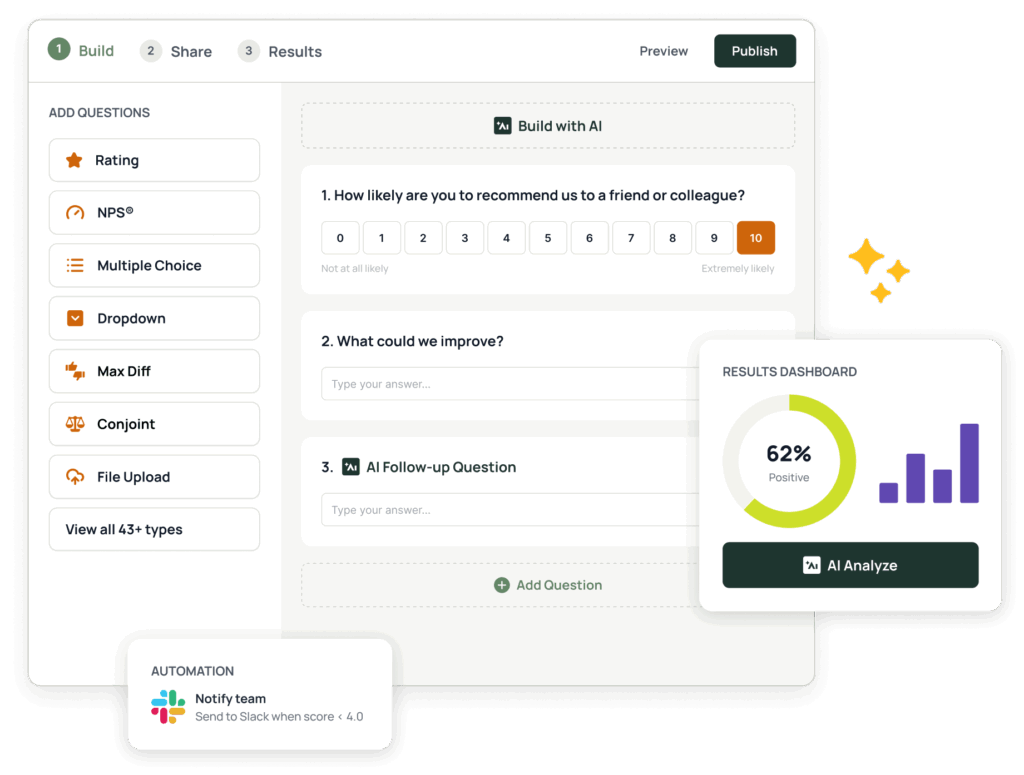
Who Is Alchemer's NPS Software Best For?
Alchemer’s NPS software is best for mid-market and enterprise organizations that need to run NPS programs at scale, combine NPS with other customer feedback, analyze both scores and comments, and route insights to the right teams. It’s designed for teams that want to move beyond dashboards and act on what customers say, without taking on the complexity of an enterprise suite.
Alchemer is a strong fit if you need to run NPS at scale, customize surveys and workflows without IT, combine NPS with other feedback, analyze scores and comments together, and route insights into the systems your teams already use. Here’s how different teams put it to work:
- Customer Experience: CX teams need a consistent read on loyalty across the journey. With Alchemer, they track relationship and transactional NPS by touchpoint and report trends to leadership.
- Customer Success: Customer success teams need early warning on at-risk accounts. Alchemer sends alerts when high-value accounts turn detractor, with the comment and account data attached.
- Product: Product teams need evidence for the roadmap. Alchemer routes product-related comments to the right owners, and theme analysis shows which issues move NPS most.
- Marketing and Insights: Marketing and insights teams need advocates, proof points, and segment insight. They use Alchemer to identify promoters for reviews and references and to compare NPS drivers across segments.
- Support: Support teams need feedback tied to agents and issue types. Alchemer sends transactional NPS after each resolution, so managers can coach on real signals
NPS vs. CSAT vs. CES: Which CX Metric Should You Use?
Net Promoter Score (NPS) measures customer loyalty and likelihood to recommend. Customer Satisfaction Score (CSAT) measures satisfaction with a specific interaction. Customer Effort Score (CES) measures how easy or difficult an experience was. Each answers a different question, and they’re more useful together than alone.
| NPS | CSAT | CES | |
|---|---|---|---|
|
What it measures |
Loyalty and willingness to recommend |
Satisfaction with a specific moment |
Effort required to complete a task |
|
Typical question |
“How likely are you to recommend us?” |
“How satisfied were you with your experience?” |
“How easy was it to resolve your issue?” |
|
Typical scale |
0–10 |
1–5 |
1–7 |
|
Best timing |
Relationship cadence, or after key milestones |
Right after an interaction |
Right after a task |
|
Best for |
Tracking long-term loyalty and advocacy |
Evaluating individual touchpoints |
Identifying friction in specific customer experiences |
|
Limitation |
Doesn’t pinpoint which interaction caused the score |
Can miss the bigger loyalty picture |
Narrow in scope |
Think of them as three views of the same customer. CSAT tells you whether an interaction landed. CES tells you whether it was easy. NPS tells you whether the sum of those moments earned loyalty. The Buffalo Sabres track NPS and CSAT in the same post-game survey, alongside purchase intent and word of mouth, so they can see how each gameday experience connects to overall fan loyalty.
Alchemer lets you run NPS, CSAT, and CES from the same platform, so the results land in the same dashboard and the same workflows.
How NPS Survey Platforms Compare
NPS software falls into four broad groups: dedicated NPS tools, general survey platforms, enterprise experience management suites, and customer feedback platforms. The table below compares Alchemer with four platforms buyers may consider when evaluating NPS survey software.
| Category | Alchemer | Qualtrics | Medallia | SurveyMonkey | QuestionPro |
|---|---|---|---|---|---|
|
Platform type |
Customer feedback and intelligence platform |
Enterprise experience management (XM) suite |
Enterprise experience management suite |
General-purpose survey platform |
Survey and CX platform |
|
Best fit |
Mid-market and enterprise teams running NPS alongside CSAT, CES, digital, and review feedback |
Large enterprises standardizing on one XM suite across CX, EX, and research |
Large enterprises with complex, multi-channel CX programs |
Teams that want fast, general-purpose surveys with NPS templates |
Mid-market teams that want a survey and CX toolset with NPS included |
|
NPS survey capabilities |
Native NPS question type, score-based branching, NPS chart reporting |
NPS available within the broader XM platform |
NPS measurement within Medallia’s experience platform |
NPS survey template, NPS calculator, and benchmarks |
Customizable NPS templates and dashboards |
|
Open-text analysis |
Alchemer Pulse: sentiment, automatic themes, and Impact Analysis by NPS |
Text analytics through the XM platform, including Clarabridge |
Machine learning–based text analytics |
Analysis tools for open-ended responses |
Text analytics available |
|
Closed-loop workflows |
Alerts and routing with 400+ integrations |
Routing and case management within the suite |
Role-based reporting and action tools |
Detractor alerts and integrations |
Follow-up workflows available |
|
Beyond NPS |
CSAT, CES, in-app feedback, product feedback, research, and reviews in one platform |
CX, EX, and research programs |
CX, EX, contact center, and market research |
Broad survey library and forms |
Broad survey and CX features |
|
Time to launch |
Surveys in minutes, programs live in days to weeks |
Varies by suite and scope |
Varies by suite and scope |
Fast to start |
Quick to launch |
|
Support model |
Named customer success manager, 24/7 availability, and 94 NPS for support |
Tiered support |
Tiered support and services |
Standard support |
Standard support |
Alchemer’s differentiator centers on operational flexibility rather than analytical breadth. Enterprise-grade capability, faster implementation, full data ownership, and a program you can change yourself when the business question changes. Ryder chose it for exactly that reason after finding other enterprise platforms required specialized developers and significant implementation investment.
Why Organizations Choose Alchemer for NPS
Organizations choose Alchemer for NPS when they want the score to lead somewhere. Here’s how the platform supports six core NPS needs. Underneath all of these traits: SOC 2 Type II certification, GDPR compliance, HIPAA-ready configurations, and implementation measured in days. Alchemer serves more than 11,000 customers across 100+ countries, offers a dedicated customer success manager and 94 NPS for support, and earned five G2 badges in Spring 2026, including Fastest Implementation (Enterprise) and Best Estimated ROI (Enterprise). Alchemer was also positioned as a Challenger in the 2026 Gartner® Magic Quadrant™ for Voice of the Customer Platforms.
Customizable Programs
Build relationship and transactional NPS side by side with score-based branching and your own branding, and change them yourself as questions evolve.
Touchpoint Coverage
Send NPS by email, SMS, web, QR code, and in-app through Alchemer Digital Experience, and add reviews from Google, Yelp, app stores, and 200+ industry sites.
Quantitative and Qualitative Analysis
Alchemer Pulse assigns sentiment and groups comments into themes. Recognized by Forrester in its GenAI best practice report for customer feedback management.
Automated Workflows
Detractors reach an owner. Promoters reach your advocacy program. Nobody has to check a dashboard to find out who needs a call.
Connected Systems
400+ integrations, including Salesforce, Zendesk, HubSpot, Slack, and Microsoft Teams.
One View of the Customer
NPS, CSAT, CES, product feedback, digital feedback, and reviews in one platform.
NPS Customer Success Stories
Great NPS programs share a pattern: they collect the score, learn the reason, and act while the customer still cares. Here are two examples.
- Choose a story below
Buffalo Sabres
The Buffalo Sabres don’t just sell tickets — they sell a game day experience that runs from the moment fans arrive downtown to the final horn. Before Alchemer, the team collected fan feedback, but not at the depth, speed, or scale they needed to act on it.

The team built “Gameday Pulse,” a survey sent after every home game that benchmarks four KPIs: NPS, CSAT, purchase intent, and word of mouth, alongside diagnostics like concessions, atmosphere, and arena entry and exit. Advanced logic and branching serve different questions to different fan segments, and results flow to the Sabres’ analytics tools.
With Alchemer Pulse, the team analyzed more than 40,000 open-text responses and used the themes to guide decisions: feedback confirmed a new video board investment, and concessions comments led to a food program rebuilt with local vendors, Buffalo-area breweries, and cashless market-style stands. Fan survey participation doubled year over year, and CSAT, NPS, and arena atmosphere ratings all posted double-digit gains.
Malwarebytes
Malwarebytes had outgrown its survey tool and wanted an NPS program the whole business could use. Open-text feedback held the real insight, but analyzing it by hand took time the team didn’t have.

With Alchemer, Malwarebytes standardized its NPS and customer feedback program and automated routing to the right teams, with results syncing in real time to Salesforce and Zendesk. Anyone who scores a seven or below now hears from the team within 24 hours, and happy customers are invited to share reviews on Trustpilot, Amazon, and G2. The company runs tens of thousands of consumer surveys and hundreds of business NPS surveys each month.
After adding Alchemer Pulse, the team found 15 customer segments where they had assumed seven. Results include four product launches informed by customer sentiment, a 60+ point lift in sentiment score, and double-digit revenue growth in a mature market. Executives now use NPS and sentiment insights to set annual benchmarks and strategic goals.






What Customers Are Saying About Alchemer's NPS Software



A great NPS program doesn’t stop at the number. See how Alchemer helps you collect feedback, understand why customers scored you the way they did, route insights to the right teams, take action, and measure improvement.
Related NPS Resources

Using Net Promoter Scores (NPS) to boost customer satisfaction and loyalty
Net Promoter Score (NPS) is a simple but powerful tool that packs a serious punch. It’s a single, insightful metric that helps you...

Survey Software: Tools, Platforms, and Buyer's Guide
Smart thinking: you’ve decided to use a survey to gather feedback on your company’s customer experience (CX)...

Alchemer Positioned As A Challenger In The 2026 Gartner® Magic Quadrant™ For Voice Of The Customer Platforms
Included for the fifth consecutive time for its Ability to Execute and Completeness of Vision...
NPS survey software is a platform that helps organizations create Net Promoter Score surveys, distribute them across channels, calculate and track scores, and analyze the feedback behind them. More advanced platforms, like Alchemer, also segment promoters, passives, and detractors, route responses to the right teams, and trigger follow-up so customer feedback leads to action.
It depends on what you need after the score. Dedicated tools like AskNicely and Retently suit small teams that need a score and trend line. Platforms like Alchemer, Qualtrics, Medallia, SurveyMonkey, and QuestionPro suit broader programs. Alchemer is best for mid-market and enterprise teams that combine NPS with other feedback, analyze comments with AI, and route insights into existing systems.
Start with what you want to happen after the score arrives. Evaluate how quickly you can launch, how flexible the surveys are, which channels you can use, how the tool analyzes open-text, whether it automates alerts and routing, how well it integrates with your CRM and support systems, and whether it can scale with your program. Then decide whether you need a dedicated NPS tool or a broader customer feedback platform.
Look for customizable NPS surveys with branching logic, multi-channel distribution, automated triggers, dashboards and reporting, open-text and AI-powered analysis, segmentation, real-time alerts, workflow automation, CRM and helpdesk integrations, role-based reporting, enterprise security, custom branding, and an open API.
Subtract the percentage of detractors (scores 0–6) from the percentage of promoters (scores 9–10). Passives (7–8) count in the total responses but not in the subtraction. For example, if 52% of respondents are promoters and 20% are detractors, your NPS is 32. Scores range from -100 to +100.
Any score above 0 means you have more promoters than detractors. Commonly cited guidance treats above 20 as favorable, above 50 as excellent, and above 80 as world class, though benchmarks vary widely by industry. The most useful comparison is your own trend: a score that improves quarter over quarter shows your program is working.
Pair a metric question with diagnostic follow-up. Useful examples include “What’s the main reason for your score?”, “What were you trying to accomplish?”, “What’s the one thing we could change that would matter most to you?”, and “Have you considered alternatives in the last six months?” Keep the survey short and ask one idea per question.
NPS measures loyalty and likelihood to recommend your company, product, or service. CSAT measures satisfaction with a specific interaction, like a support call or a purchase. NPS shows the long-term relationship; CSAT shows how individual moments land. Most programs use both, often alongside Customer Effort Score (CES).
Yes. Modern NPS software can send surveys on a schedule or after specific events, apply frequency caps, and trigger alerts and follow-up based on score or comment. In Alchemer, integrations, API, and webhooks automate sends, and workflows route responses to owners without manual forwarding.
Segment the score by customer type, product, region, or touchpoint. Then analyze open-ended comments for sentiment and themes, and rank themes by their effect on your score. AI-powered text analysis scales past what manual coding can handle. Alchemer Pulse groups comments into themes and shows which drive promoter and detractor scores.
Set a response window, assign an owner, and give that owner the comment and account context. Reach out personally, resolve the issue where possible, and tell the customer what changed. Malwarebytes contacts anyone who scores a seven or below within 24 hours. Automating alerts and routing makes that speed repeatable.
Yes. Strong NPS platforms sync with CRM and support systems so each score sits next to the account it belongs to. Alchemer offers native Salesforce and Microsoft Excel bi-directional sync, connections to HubSpot, Zendesk, Slack, and Microsoft Teams, and 400+ integrations, plus an open API and webhooks.
Share them, act on them, and measure again. Route detractor feedback to owners for follow-up, send product themes to Product, invite promoters to leave reviews or join a reference program, and track whether score and sentiment change after you act. Results that don’t lead to a decision are just data.