- Resource Library
- Research Report
- 2026 Hospitality Benchmarks: Hotels vs. Vacation Rentals
2026 Hospitality Benchmarks: Hotels vs. Vacation Rentals
A data-backed analysis of the loyalty battle between hotels and vacation rentals

Introduction
There’s a growing divide in the hospitality market, and it’s largely defined by age. Older travelers are sticking with hotels, while younger travelers are increasingly choosing vacation rentals.
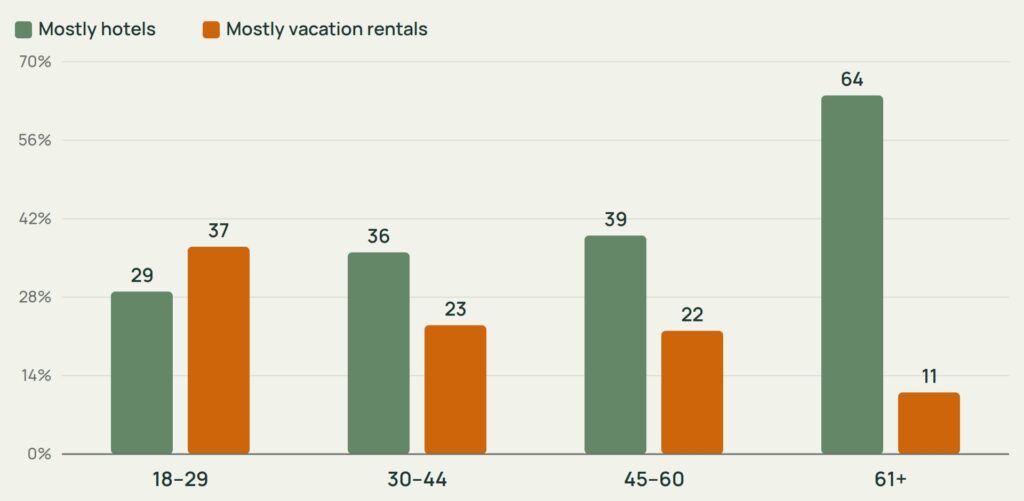
According to Alchemer’s 2026 Hospitality Benchmark Study, 64% of travelers 61 and older plan to book mostly hotels in the next 12 months, and just 11% lean toward short-term rentals. Under-30s flip the script: 37% lean mostly rentals versus 29% mostly hotels.
Lodging preference is splitting along generational lines, and the younger half of that split is both the future of the market and the toughest to retain. This report unpacks what’s behind that divide and what it means for your brand. You’ll learn:
- How hotels and vacation rentals compare on loyalty and guest sentiment
- Why cleanliness is a prerequisite for success
- What actually makes guests pick a rental over a hotel
- Why Gen Z is the toughest guest to please
- Where hotels are dropping the ball on feedback follow-through
- Why online reviews are critical for younger guests and barely register with older travelers
The Underdog is Winning — Rentals Pull Ahead of Hotels on Loyalty
For decades, hotels owned hospitality. Brand recognition, loyalty programs, a front desk staffed around the clock. Rentals were the scrappy alternative — cheaper, a roll of the dice on a stranger’s spare room. So here’s the plot twist: vacation rentals are now overtaking hotels on loyalty as Airbnbs, Vrbos, and other rentals continue to grow and mature in the market.
| How was your last experience? | Hotel | Vacation rental |
|---|---|---|
| Very positive | 66.0% | 69.2% |
| Positive experience | 93.0% | 96.4% |
| Neutral | 5.5% | 2.9% |
According to Alchemer’s 2026 Hospitality Benchmark Study:
- Rentals post a Net Promoter Score (NPS) of 50.9 against hotels’ 41.8 — a roughly 9-point gap, which is a chasm in NPS terms.
- Rentals turn more guests into promoters (60.9% vs. 55.5%) and produce fewer detractors (10.0% vs. 13.7%).
- The overall experience scores line up the same way: 96.4% of rental guests rate their stay positive, versus 93.0% for hotels.
Vacation Rentals Lead Hotels on Loyalty
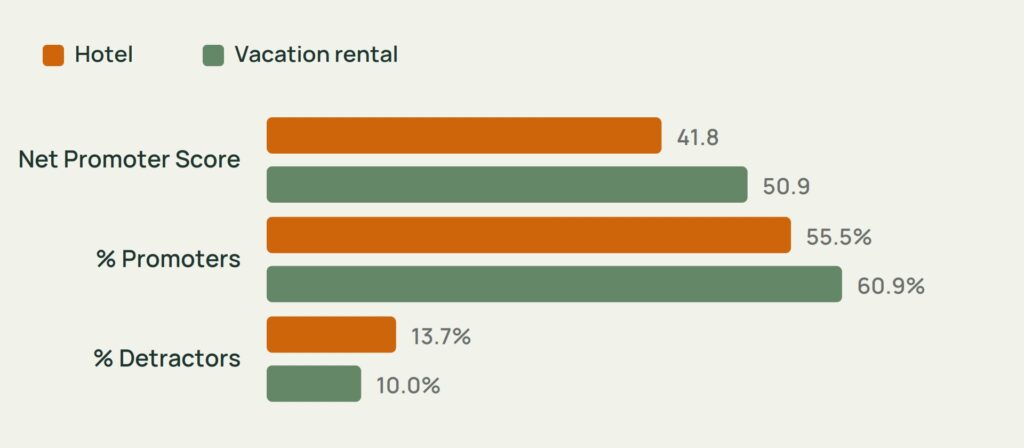
Why is the underdog pulling ahead? Younger travelers lean rental, they’re the most enthusiastic when a stay lands, and they’re pulling the whole category’s loyalty numbers up with them.
However, there’s a real caveat hiding in the data. Hotels still win on near-term intent — 42% of travelers over 40 plan to book mostly hotels in the year ahead, versus 23% mostly rentals. Older, hotel-loyal travelers anchor that gap, and they book a lot of rooms.
Vacation rentals are more loved today, but hotels still fill more beds tomorrow. However, the travelers who love rentals most are the ones with the most booking years ahead of them. The travelers anchoring hotels’ lead are further along in their traveling lives.
Today’s preference becomes tomorrow’s default, and the generation forming its habits right now is forming them around rentals.
Where Each Age Group Plans to Mostly Stay Next Year
Gen Z: Your Toughest Guest and Your Biggest Opportunity
Across every satisfaction and loyalty measure in the study, the youngest travelers are the toughest crowd on the property.
According to Alchemer’s 2026 Hospitality Benchmark Study, 18– to 29-year-olds post the lowest satisfaction at 57% “very positive,” compared to roughly 70% for older groups. They report problems at a staggering rate — 35% flagged an issue that needed attention, versus just 8% of travelers 61 and older. They’re the quickest to dispute a charge, with only 28% saying they’ve never done it (next to 71% of the 61+ crowd). And as the lead made clear, they’re the least likely to come back, with just 39% “very likely” to rebook.
Younger Guests More Likely to Hit Problems and Act on Them
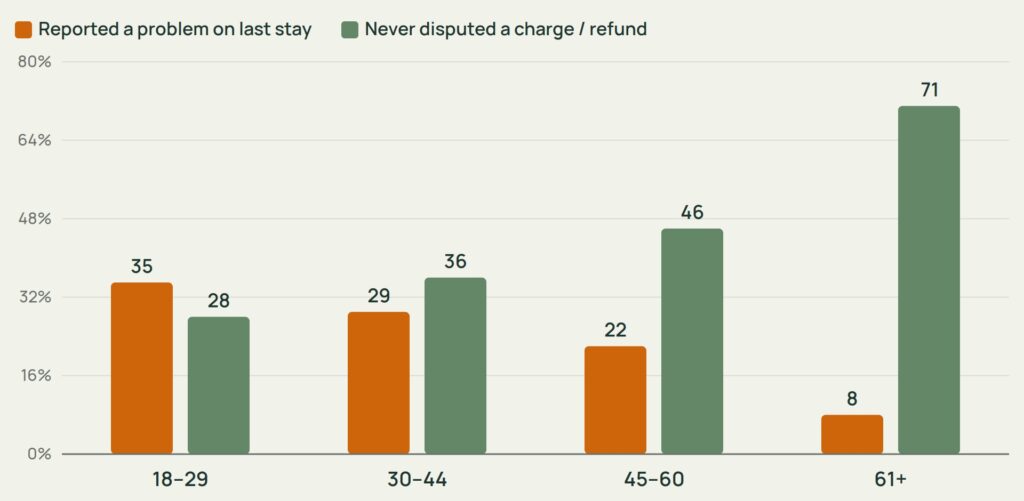
A demanding, skeptical, hard-to-retain customer sounds like a problem. It’s actually an opportunity.
Young travelers’ complaints focus around check-in speed and support responsiveness, which are concrete, fixable, unglamorous problems. You can’t always fix “the vibe was off.” You can absolutely fix a 20-minute check-in line. The hardest guest to please is also the most winnable, because they hand you the feedback and blueprint to winning them.
Cleanliness Beats Everything — Even Price
Travelers will forgive a lot. What they won’t forgive is a dirty room.
According to Alchemer’s 2026 Hospitality Benchmark Study, cleanliness is the number one experience driver at 63%, well ahead of cost and value at 44.8%. It’s the top reason a stay stood out as the best (48.3%), the top complaint when something goes wrong (41.7%), and the top reason guests withhold a 5-star review (47.1%).
It holds everywhere. For Hotels (61.8%) and rentals (64.4%), cleanliness leads across every age group. Think of it as the price of entry, not a differentiator.
So, what actually creates promoters once a property is clean? Two things rise to the top: total cost / value for money (44.8%) and comfort (37.5%).
| What is most important to you? | Overall | Hotel | Rental |
|---|---|---|---|
| Cleanliness of the property | 63.0% | 61.8% | 64.4% |
| Total cost / value for money | 44.8% | 45.9% | 43.4% |
| Comfort of the bed and room | 37.7% | 41.7% | 33.0% |
| Ease and speed of check-in | 37.2% | 34.8% | 40.1% |
| Quality of customer support | 31.6% | 28.9% | 34.7% |
| Amenities (Wi-Fi | kitchen | pool…) | 15.7% |
| Location / neighborhood | 12.9% | 13.0% | 12.8% |
| Safety and security | 12.5% | 13.6% | 11.2% |
| Transparency of fees and charges | 11.6% | 8.2% | 15.5% |
| Space for a larger group | 4.8% | 2.8% | 7.2% |
Hotels vs. Vacation Rentals: How Do Guests Choose?
Ask a hotel and a rental guest why they booked, and you’ll get two completely different answers. They’re not weighing the same trade-offs and both guests value different things.
Hotel loyalty runs on trust, safety, and the comfort of knowing exactly what you’re getting. In Alchemer’s 2026 Hospitality Report, the single most common reason guests pick hotels is simple: 25.6% just trust hotel brands more. Safety and security (19.3%) and a 24/7 front desk follow close behind. A hotel is a known quantity. Someone’s always there, the standards are set, and the pillows are the same in Denver as they are in Dallas.
Vacation rental guests want the opposite of standardized — they want space and a place that feels lived-in. More space for the price tops their list at 55.4%, with a full kitchen right behind at 50.7%. Then come the things a hotel room can’t easily offer: room for the whole group (44.5%), real privacy (43.3%), and a home-like, local feel (37.2%). They’re booking more than a room, rather booking a temporary home base.
Hotels should defend their trust advantage while raiding rental turf — clearer total pricing, sharper space-and-value messaging, and suite or kitchenette options for groups and longer stays. Rentals should go straight at their weak spot: trust. Verified cleaning standards, responsive host support, transparent all-in pricing, and visible safety signals are how a rental closes the one gap hotels still own.
Hotels Selected for Trust; Rentals for Space and Value
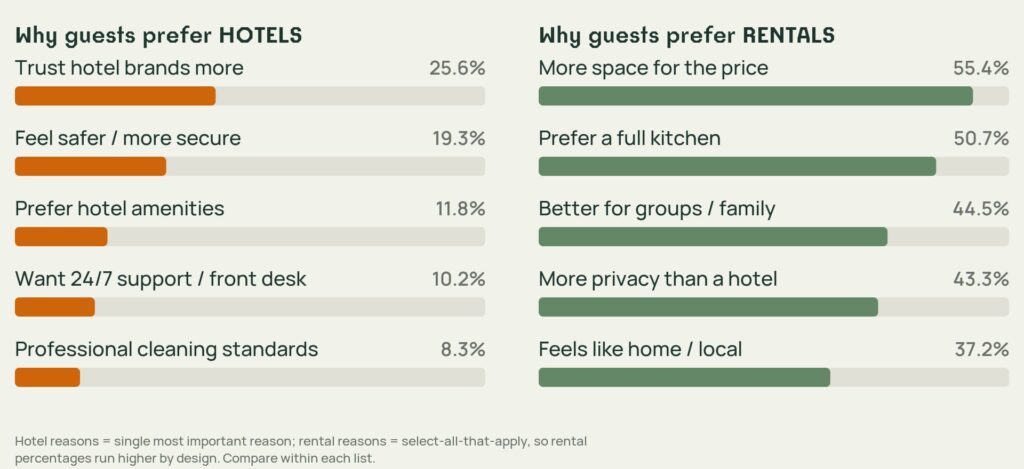
If You Ask For Feedback — Use It
Every hotel asks how your stay was. Far fewer do anything about your answer. That gap — between collecting feedback and acting on it — is where loyalty quietly breaks.
According to Alchemer’s 2026 Hospitality Benchmark Study, only about 1 in 5 guests who give feedback ever see a visible change come from it. Acknowledgment is easy and common — 57% of feedback-givers get a thank-you or a reply. Visible action is the rare part. That’s the listening-versus-proving-you-listened gap, and it’s precisely where a satisfied guest shifts into a quiet detractor.
| Were you asked to provide feedback? | Overall | Hotel | Rental |
|---|---|---|---|
| Provided feedback | 62.6% | 54.9% | 71.1% |
| Asked, but didn't respond | 18.6% | 21.8% | 15.1% |
| Never been asked | 18.8% | 23.4% | 13.8% |
Hotels are the weaker performer here. They leave 20.4% of feedback-givers with absolutely nothing back, against 11.9% for rentals. Short-term rental hosts close the loop more reliably, almost certainly because platforms bake review prompts and host follow-up right into the booking flow — the loop closes whether the host is thinking about it or not.
Hotels also have a problem upstream, and it’s the easiest fix in this entire report: a lot of guests are never even asked. 23.4% of hotel guests say no one ever requested their feedback, versus 13.8% for rentals. And it’s not because asking is hard — 97.8% of guests who gave feedback found it easy to do. The friction isn’t in the survey. It’s in remembering to send it, and in doing something visible once it comes back.
| What happened after giving feedback? | Overall | Hotel | Rental |
|---|---|---|---|
| Received an acknowledgment | 57.3% | 56.7% | 57.8% |
| Received a personal follow-up response | 41.1% | 36.2% | 45.3% |
| Saw a visible improvement or change | 21.7% | 17.0% | 25.7% |
| Received some compensation | 16.2% | 14.3% | 17.7% |
| Nothing | 15.8% | 20.4% | 11.9% |
| Not sure | 2.6% | 2.7% | 2.5% |
Win on Reviews, Win the Next Generation
For younger generations reviews are your very public front door. Get reviews right and you’re in the running. Get them wrong and you’re invisible or easily avoidable. Remember, 48% of guests leave a review after a bad experience.
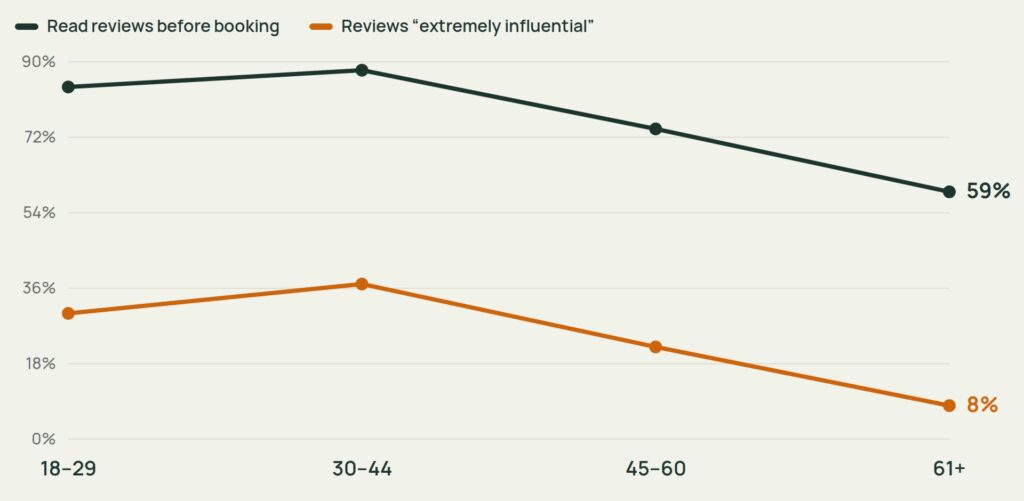
In Alchemer’s study, 87% of 30 to 44-year-olds read reviews before booking, and reviews are “extremely influential” for 37% of them — by far the most review-driven group in the study. These are the travelers booking the most trips, researching the hardest, and deciding where to stay based on what other guests say. Your review profile is your pitch to them, whether you’re managing it or not.
The contrast with older guests makes the point even sharper. Just 59% of travelers 61 and older read reviews before booking, and only 8% find them “extremely influential.” What wins the older crowd is familiarity — past experience with a brand or host climbs steadily with age, from 12% of 18 to 29-year-olds to 30% of those 61 and older. Older travelers trust their own history and experience. Younger travelers trust the receipts.
How Guests First Find a Stay
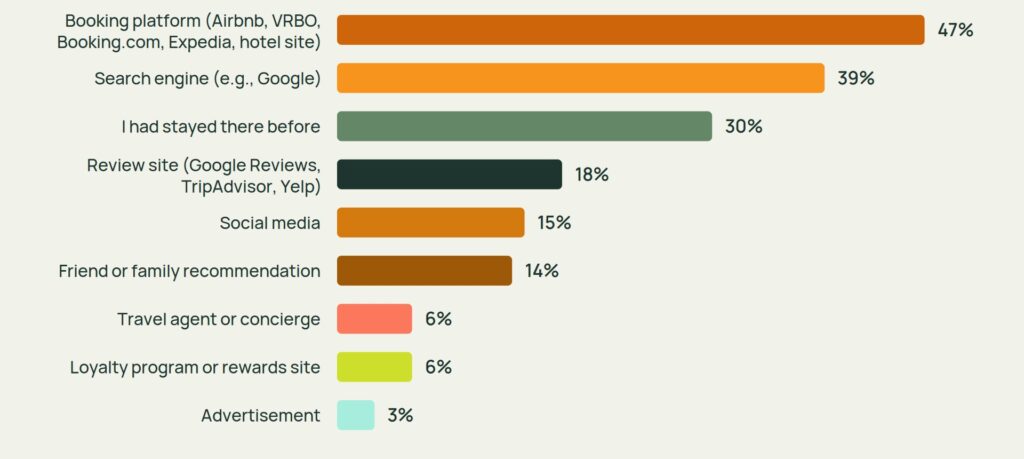
That’s the strategic split, and it tells you exactly where to spend. The brands chasing growth are chasing younger travelers, and younger travelers live in the reviews. Rentals already understand this instinctively — with no brand to lean on, they win or lose on star ratings, and their bookings flow straight from their reputation. Hotels can’t coast on brand familiarity here. The loyalty programs and name recognition that hold older guests do almost nothing for the under-40 traveler scrolling through ratings before they book.
So treat reviews as a growth engine, not a report card. Ask for them while the stay is fresh, respond to them publicly and fast, and feed what they tell you back into the experience. Every review you earn is a vote in the only forum the next generation actually trusts.
Review Impact Fades With Age
Five Ways to Win in Hospitality
- Stop designing for the “average guest.” That person doesn’t exist. A hotel guest and a rental guest are buying different products, so segment your experience strategy by lodging preference instead of a blended persona that satisfies no one.
- Cleanliness is non-negotiable — everywhere. It’s the top driver and the top complaint, all at once. Win here before you spend a dollar on anything fancier.
- Find key friction points and address them. Hotels: defend comfort and value, and make the total price clear up front. Rentals: go after fee opacity, check-in friction, and the missing-support gap.
- Win on reviews to win the next generation. Younger, high-frequency travelers book on the crowd’s word, not yours. 87% of 30 to 44-year-olds read reviews before booking, and reviews barely move older guests. Ask while the stay is fresh, respond publicly and fast, and feed what they tell you back into the experience.
- Close the loop, or watch promoters leak away. Only about 1 in 5 guests who give feedback ever see a visible change. Acknowledgment is easy; action is rare. Collecting feedback is the starting line, responding is necessary and change is what creates satisfied, loyal guests.
How Alchemer Helps Brands Do More With Feedback
The data points to one conclusion: the brands that win in 2026 are the ones that ask the right guests the right questions, then visibly act on what they hear. Alchemer is purpose-built for exactly that — collecting feedback across every channel, acting on it automatically, and closing the loop so guests see their input turn into change.
Listings, Review & Reputation Management
Younger travelers book based on what other guests say, and 87% of your highest-value bookers read reviews before they reserve. Monitor and respond to reviews across Google, TripAdvisor, and the platforms your guests actually use — all from one place. Protect your reputation, respond fast, and pull out the themes driving sentiment across every location, so you know what’s working and what’s quietly costing you bookings.
Omnichannel Feedback Collection
Trust isn’t built in one place, and your ability to measure it shouldn’t be either. Collect real-time feedback wherever guests are — email, mobile app, in-stay QR codes, post-stay surveys, and kiosks — so you catch friction in the moment instead of reading about it in a one-star review later. With 40+ question types, multilingual support, and advanced logic, Alchemer makes it easy to hear from every guest across every property without piling work on your team.
Integrations & Closed-Loop Action
Collecting feedback is only half the job — acting on it is where loyalty is won or lost. Only about 1 in 5 guests ever see a change come from their feedback, and that gap is where promoters turn into detractors. Alchemer Connect integrates feedback directly with the systems your properties already rely on, routing responses to the right team, triggering service-recovery workflows, and automatically closing the loop back to the guest. No signal gets stuck in a survey tool no one’s watching. one’s watching.
AI-Powered Dashboards & Sentiment Analysis
A hotel guest and a rental guest aren’t the same customer, so a blended average hides more than it reveals. Alchemer Dashboard brings guest, location, and staff feedback into one centralized view, with role-based dashboards for property managers, regional leaders, and executives. Purpose-built AI like Alchemer Pulse analyzes open-text feedback for themes and sentiment — by lodging type, location, or traveler age — so you can spot retention risk building before it becomes churn, and act on it while it still matters.
- 63% of guests say cleanliness is the most important factor in their hotel or rental experience.
- 44.8% of guests say cost and value is the most important factor in their hotel or rental experience.
- 41.7% of guests say their top complaint about a hotel or vacation rental is cleanliness.
- 47.1% of guests say cleanliness is the top reason they withhold a 5-star review from their hotel or rental experience.
- 87% of 30- to 44-year-olds read reviews before booking a hotel or rental, and 7% say that online reviews are “extremely influential” to their decision of where to stay.
Related Resources
What 1,400 Guest Reviews Reveal About the Modern Hotel Experience
An analysis of check-In, loyalty, amenities, and service at Hyatt, Hilton, and IHG
Read the report

Alchemer for Hospitality
Alchemer gives you the feedback tools to improve operations, engage employees, and deliver standout guest experiences.
Learn More

This report examines the growing loyalty battle between hotels and vacation rentals, revealing how guest preferences diverge across generations—and what those shifts mean for the future of hospitality.