- Resource Library
- Research Report
- 2026 Holiday Shopper Report: 7 Key Loyalty Insights
2026 Holiday Shopper Report: 7 Key Loyalty Insights
How to Improve the Shopping Experience Ahead of the Holiday Season

Introduction
Ahead of the busy holiday shopping season, shoppers aren’t asking retailers to reinvent the retail experience — rather asking retailers to just get the basics right: products consistently in stock, smooth checkout, and quick resolution when service or experience issues arise.
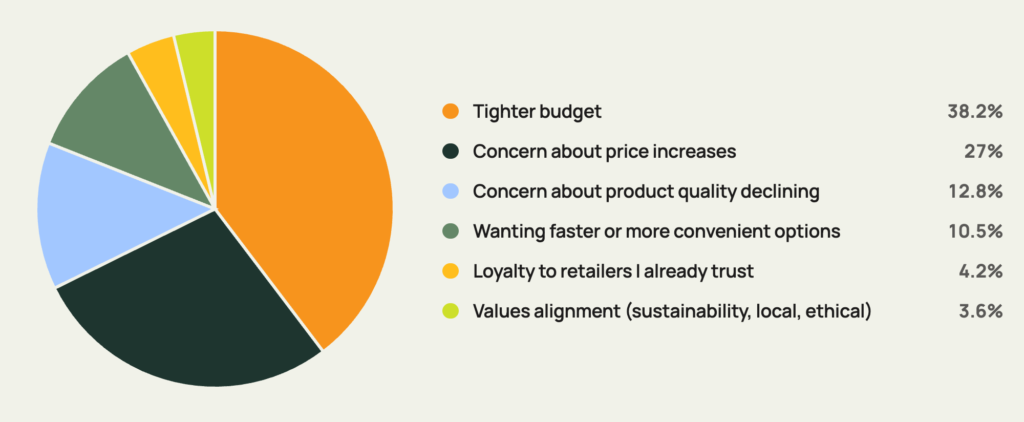
The fundamentals are even more important in a year where shoppers watch every dollar. Nearly four in 10 say a tighter budget will have the biggest impact on their holiday spending, while another quarter of consumers expect rising prices to force tougher choices. When money is tight, patience disappears and small moments of friction become reasons to leave.
To understand what separates the retailers that will earn repeat business this holiday season from those that quietly lose it, Alchemer surveyed over 1,000 U.S. shoppers across age groups, genders, and shopping channels.
The findings point to seven clear priorities for retailers heading into the 2026 holidays.
The 2026 Holiday Shopper, in Brief
Sentiment looks healthy on the surface. Most recent purchases landed well, and most shoppers say they’d come back. But that surface stability sits on top of constant churn and a shopper who is quicker to leave than last year’s numbers would suggest.
| Headline metric | Result |
|---|---|
| Overall experience (most recent purchase) | 80.6% positive (51.5% "very positive") |
| Likely to buy from that retailer again | 78.4% likely (42.3% "very likely") |
| Started shopping somewhere brand-new (past 12 mo.) | 40.1% |
| Expect to spend more this holiday vs. last year | 37.0% (14.7% "much more") |
The holiday overlay sharpens everything. When asked what factors will impact holiday shopping, budget pressure and price anxiety dominated. That’s the backdrop for all seven priorities below. This is a value-first, low-patience shopper — and the retailers who win the season will be the ones who remove friction and respect shoppers’ time and money.
The Biggest Factors Shaping Holiday Shopping
| Where shoppers expect to do most holiday shopping | % expecting to shop there most |
|---|---|
| Physical stores | 35.8% |
| Online (retailer site/app) | 31.1% |
| An even mix of online and in-store | 19.2% |
| Marketplaces (Amazon, Walmart, etc.) | 6.9% |
| Social media or creators | 1.5% |
| AI tools (ChatGPT, Claude, Perplexity, etc.) | 0.3% |
1. Fix Availability and Checkout Friction Before Peak Season
The two biggest frustrations in the entire survey are the two things a busy store is most likely to get wrong in December: empty shelves and slow lines.
Asked about their worst experience of the past year, shoppers put out-of-stock items on top at 41%, with long or slow checkout close behind at 30.6%. Hidden fees at checkout (32.3%) and simply not finding what they came for (25.8%) round out the top tier.
| Top frustration (worst experience of the year) | % who cited it |
|---|---|
| Items out of stock | 41.0% |
| Hidden fees or unexpected charges at checkout | 32.3% |
| Long lines or slow checkout | 30.6% |
| Difficulty finding what I was looking for | 25.8% |
| Unhelpful, unavailable, or rushed staff | 18.0% |
| Delivery taking longer than promised | 15.9% |
| Damaged or incorrect items received | 12.6% |
| I did not have a frustrating experience | 13.1% |
2. Ask for Shopper Feedback and Then Act on It
This is the biggest gap in the data, and the holiday rush widens it. Most frustrated shoppers never tell you anything is wrong and then take their gift budget elsewhere.
Nearly half of shoppers (47.7%) have chosen not to give feedback after a frustrating experience. The following reasons are a warning: they don’t think it’ll change anything, it’s too much effort, or they’ve already decided to shop somewhere else.
| Why frustrated shoppers stay silent | % who cited it |
|---|---|
| "I didn't think it would change anything" | 42.1% |
| "Too much effort" | 41.5% |
| "I just stopped shopping there instead" | 32.9% |
Even when shoppers do speak up, the follow-through collapses. Barely half get an acknowledgment, a third get a personal response, and only about one in five ever sees a change. Roughly one in five gets nothing back at all.
The distance between hearing someone out and showing them that you acted is where a promoter quietly becomes a detractor. Most retailers already collect lots of consumer feedback. What they lack is an easy way to route it, act on it, and close the loop back to the shopper.
3. Treat Service Recovery as a Loyalty Lever, Not a Cost Center
Holiday shopping generates more service issues than any other time of year — wrong sizes, late deliveries, damaged gifts. How a retailer handles those moments is one of the clearest dividing lines between a shopper who stays and one who leaves.
These stakes are high. Poor customer service is the second most-likely reason a shopper would abandon a retailer they currently like (19.3%), trailing only a significant price increase. Service isn’t a soft metric here — it’s a defection trigger, right behind price.
What happened after you raised a recent issue?
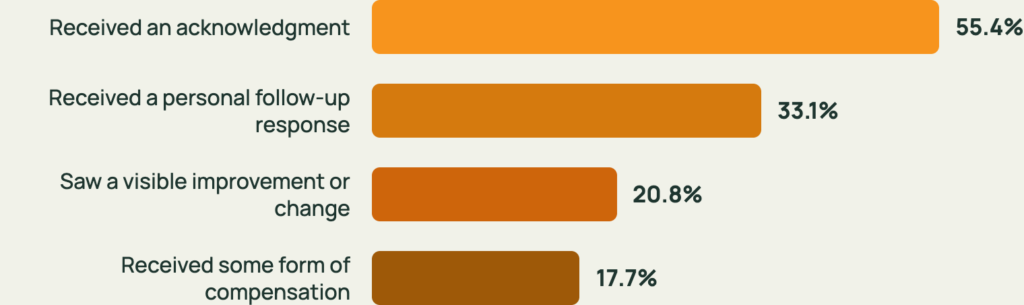
The gap between an acknowledgment and a real fix is where recovery breaks down. Fewer than one in five shoppers who flagged a problem got any compensation, and even fewer shoppers saw a change. During a season when a botched gift order has a hard deadline and an obvious alternative down the street, “we’ve received your feedback” isn’t enough.
The implication is a staffing and empowerment one. A frontline team (both in-store and online) that can make it right on the spot — a fast replacement, a refund, a genuine fix — will outperform a policy that routes every holiday hiccup through numerous approvals. Speed and substance are what turn a service failure into retained loyalty.
4. Defend Price and Value Above Everything Else
Price sits at the center of nearly every decision the 2026 shopper makes.
It’s the #1 driver of a good experience (65.6%) and the deciding factor at purchase (67.3%). It’s also the top reason shoppers leave: a significant price increase is the single thing most likely to push someone away from a retailer they otherwise like (42.7%), more than double the runner-up.
| What drives the experience (select up to 3) | Overall |
|---|---|
| Price and overall value | 65.6% |
| Product quality | 48.6% |
| Product availability (in stock) | 32.6% |
| Ease and speed of checkout | 22.9% |
| Quality of customer service or staff | 13.3% |
| Speed and reliability of delivery | 11.2% |
| How easy it was to find what I wanted | 10.9% |
| Cleanliness or layout of store/website | 9.1% |
Price pressure is reshaping behavior across the board. 44.1% say the lowest price matters more to them now than a year ago, and when prices rise, shoppers act — they buy less, wait for sales, and trade down.
| What shoppers do in response to rising prices | % who cited it |
|---|---|
| Buy fewer items | 46.8% |
| Wait for sales | 41.1% |
| Trade down to lower-priced brands | 35.9% |
| Delay purchases outright | 34.1% |
The reflex is to discount everything. The data points somewhere cheaper and more durable: transparency. Hidden fees are already the #2 frustration in the survey (32.3%), and no-surprises pricing shows up as a genuine loyalty driver. If a price has to rise, explain why, lead with value, and don’t hide it behind more fees.
Price sensitivity sharpens with age, and it’s older shoppers tightening budgets the most. Price and affordability as a top purchase factor climbs from 14% among 18-to-29-year-olds to 30% among shoppers 61 and older. That’s the group retailers most need to get pricing communication right for. They weight price most heavily in every decision, and they’re the most likely to pull back spending this holiday season.
5. Frontline Staff Are an Underused Holiday Lever
Ask shoppers about the best experience they had all year and they will often point to a real person.
A staff member or chat agent who went above and beyond was the second most-cited reason a best-ever experience stood out (37%), just behind the product itself. And when shoppers explain what turns a good experience into a great one, a personal touch from staff (20.7%) again lands second only to product quality.
What turns a 4-star experience into a 5-star one?
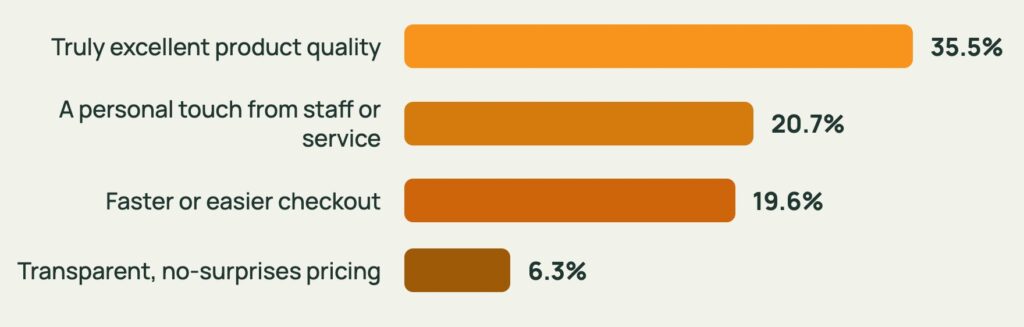
There’s a flip side worth naming. Rushed or unavailable staff are a top frustration (18%), while great staff are a top delight. Whoever’s on the floor during the holiday crush can make someone’s season or wreck their afternoon.
6. Mind the Gap Between AI Adoption and AI Trust
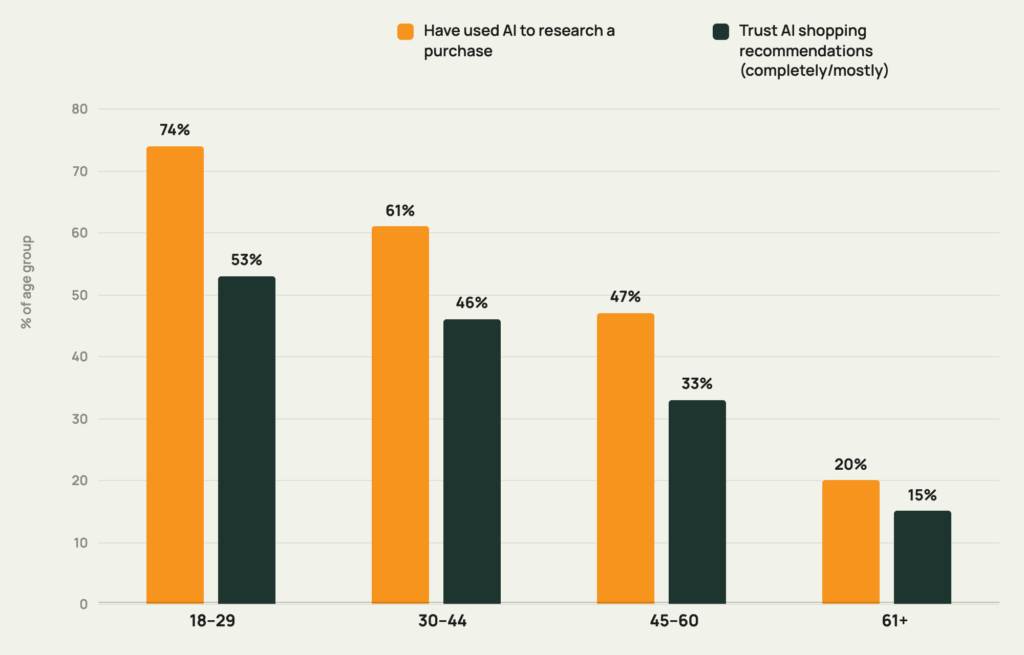
AI has changed the way people shop. Nearly half of shoppers (48.5%) used an AI tool to research a purchase in the past year, and 22.9% consistently reach for an LLM like ChatGPT, Claude, or Gemini when researching — closing in on social media (24.7%) and review sites (30.7%) as a research channel. Adoption isn’t the question anymore.
Trust is. And that’s where the two curves pull apart. Shoppers are using AI to research, but they aren’t yet leaning on what it tells them.
Only 35.4% trust AI shopping recommendations completely or mostly, and 22.2% don’t trust them at all. Just 15.4% trust AI over other sources when deciding what to buy — well behind online reviews (36.1%) and friends and family (31.2%).
Who Uses AI To Shop & Who Trusts AI Recommendations
Comfort with retailers using AI to personalize is similarly split — 41.2% comfortable, 28.9% uncomfortable, 29.8% neutral — and privacy is the single biggest concern (35.1%), ahead of fake or AI-generated content (21.4%) and biased recommendations (16.5%).
Showing up well in AI-assisted research matters now. And where AI does touch the customer, transparency closes the gap: “personalization that felt helpful, not creepy” shows up as a genuine five-star driver, while the same shoppers name privacy as their top AI fear. The retailers who earn AI trust early — especially with younger, skeptical, high-adoption shoppers — are the ones who are open about how and where AI shapes the experience.
7. Good Reviews Still Matter, Maybe More Than Ever
Reviews still decide purchases: 70.2% of shoppers read them before buying, and nearly half rate them very or extremely influential. But a credibility problem is spreading underneath, and more reviews won’t fix it — better ones will.
| Shopper concern about online review credibility | % of shoppers who cited it |
|---|---|
| Reviews may be fake or AI-biased | 42.0% |
| Reviews may be paid or incentivized | 40.6% |
| Reviews may be manipulated by brands | 32.5% |
Against that skepticism, substance wins: specific product-quality commentary matters more than the star rating or the sheer count. Which sources carry weight is worth knowing too, especially as gift research ramps up — Google and Amazon reviews lead by a wide margin.
| Most influential review sources | % citing |
|---|---|
| Google Reviews | 51.6% |
| Amazon Reviews | 40.9% |
| Reviews on retailer's website | 37.1% |
| Gen AI summaries | 13.6% |
| YouTube product videos | 12.1% |
| Trustpilot, Yelp, or similar | 11.9% |
| TikTok | 8.5% |
If holiday review-generation and social campaigns treat all shoppers the same, they’re over-investing in channels that reach half the audience.
Closing Thoughts
What the 2026 shopper wants sounds simple: the right product in stock, a fair and honest price, a fast checkout, and a real fix when something goes wrong. Delivering all of it at holiday volume, across every channel, is the hard part. And when it slips, most shoppers won’t tell you. They’ll just spend less and quietly move on.
The retailers who come out ahead won’t be the ones who never slip. They’ll be the ones who catch the friction early and act on it fast. That’s the edge this season: hearing shoppers clearly and acting before they walk. It’s what Alchemer is built for.
How Alchemer Helps Retailers Do More With Feedback
One thread runs through all seven priorities: the retailers who win in 2026 catch friction in the customer experience early, act on it fast, and show shoppers their input changed something. That’s what Alchemer is built for.
Listings, Review & Reputation Management
Seven in 10 shoppers read reviews before they buy, and more than four in 10 suspect those reviews are fake or biased. Monitor and respond to reviews across Google, Amazon, and wherever else your shoppers actually look, all from one place. Reply quickly, protect your reputation, and surface the product-quality themes that turn a wary shopper into a confident one.
Omnichannel Feedback Collection
Frustration turns up at the shelf, the register, the app, and the doorstep, so the way you catch it can’t live in one place. Collect feedback in real time across in-store QR codes, post-purchase surveys, email, SMS, and your app, and you’ll catch a stock-out or a checkout bottleneck as it happens instead of reading about it in a one-star review a week later. With 40+ question types, multilingual support, and advanced logic, Alchemer makes it easy to hear from every shopper on every channel — even at holiday volume.
Integrations & Closed-Loop Action
Collecting feedback is only half the job — acting on it is where loyalty is won or lost, and only about one in five shoppers ever sees a change come from theirs. Alchemer Connect puts feedback straight into the systems your locations already run on, routing responses to the right team, triggering service-recovery workflows, and closing the loop with shoppers automatically.
AI-Powered Dashboards & Sentiment Analysis
A budget-tightening 60-year-old and a fast-churning 22-year-old aren’t the same shopper, and a blended average buries the difference. Alchemer Dashboard pulls shopper, location, and staff feedback into one view, with role-based dashboards for store, regional, and executive leaders. Purpose-built AI like Alchemer Pulse reads open-text feedback for themes and sentiment by age, channel, or location, so you can spot churn risk building and act on it while it still matters.
- 38.2% of shoppers say a tighter budget will shape their holiday spending most, and another 27% point to concern about rising prices.
- 41% of shoppers name out-of-stock items as their #1 frustration of the past year, with slow checkout (30.6%) and hidden fees (32.3%) close behind.
- 67.3% of shoppers say price is the deciding factor at purchase, and a significant price increase is the single thing most likely to push them away from a retailer they like (42.7%).
- 47.7% of shoppers have chosen not to give feedback after a frustrating experience, and only 20.8% of those who did speak up ever saw a visible change.
- 70.2% of shoppers read reviews before buying, but 42% suspect the ones they read are fake or AI-biased.
Related Resources
The Retailer's Guide to Collecting Customer Feedback
Feedback comes from everywhere, online reviews, in-store interactions, social media, in-app feedback, and post-purchase surveys. Learn the essentials.
Read the report

Retail AI Adoption Outpaces Consumer Trust
This report examines the gap between AI adoption and consumer trust in retail, revealing how shopper attitudes split sharply by age
Learn More
This report examines what it takes to earn repeat business from the 2026 holiday shopper, revealing how a tighter budget and thinner patience turn small moments of friction into reasons to leave.