Mobile App Feedback Software for Better Customer Experiences
Mobile app feedback is the practice of collecting, analyzing, and acting on what customers tell you inside your app — through in-app surveys, ratings prompts, sentiment signals, feature requests, and open-text responses. Mobile app feedback software brings every one of those signals into one place, so product, CX, and support teams can fix friction faster, lift app store ratings, and turn real user input into better product decisions.
Mobile app feedback is how you listen at scale. App store reviews and ratings give you a valuable public signal. In-app feedback adds depth: you can ask the right customer the right question at the right moment, hear from the people who'd never think to leave a review, and connect what customers say to what you build next. Together, they give you the full picture.
By combining in-app surveys, customer sentiment signals, feature requests, and app customer reviews, organizations can better understand user needs, improve mobile app engagement, and accelerate mobile app growth.
Alchemer Digital simplifies mobile app feedback. With Alchemer Digital collect targeted, real-time feedback inside your iOS and Android apps, track customer sentiment over time, and route insights straight into the systems your teams already use — without heavy engineering lift.

Multi-Location SEO Tracking and Reporting That Drives Action
Simply put, mobile app feedback is critical for growth because retention, ratings, and revenue all run through your app experience.
Mobile is the most personal channel you have. It’s also the easiest one for customers to walk away from. Switching brands used to mean a phone call or a trip across town. Now it’s a few taps: delete one app, download another. That makes every moment inside your app a moment that either earns the next session or loses it.
For mobile-first organizations, app growth is directly tied to customer experience. Customers who encounter friction, confusing workflows, bugs, or unmet expectations often stop engaging long before they leave feedback publicly. Mobile app feedback helps teams identify those issues early, understand what customers need, and improve experiences before engagement declines.
The retention math is brutal. Average 30-day mobile app retention sits at roughly 3.7% for iOS apps and 2.1% for Android — and those numbers have been sliding year over year. The customer lifecycle on a digital property is short and getting shorter. The teams that hold on to customers are the ones who treat feedback as a daily input, not a quarterly report.
Here’s the upside: feedback moves these numbers. Brands that actively gauge sentiment and collect in-app feedback reported a 67% average 30-day retention rate for their apps — roughly seven times the industry norm. When you know how customers feel and act on it quickly, retention stops being a leak and starts being a lever.
Mobile app feedback drives these outcomes:
- Stronger retention. Catching friction in the moment keeps customers from quietly churning to a competitor.
- Lower churn. Sentiment tracking flags at-risk customers early, so you can act before they leave.
- Better app store ratings. Route happy customers to leave a review and unhappy ones to support — and watch your ratings climb.
- Smarter product decisions. Real user input replaces guesswork, so engineering time goes toward features that actually matter.
- Higher mobile app engagement. Understanding what customers value most helps teams improve feature adoption, increase session frequency, and create experiences that keep customers coming back.
- Faster mobile app growth. Organizations that continuously collect and act on customer feedback can prioritize the improvements that have the greatest impact on retention, loyalty, ratings, and long-term growth.
Bottom line: mobile app feedback isn’t a nice-to-have for digital teams chasing mobile app growth and mobile app engagement. It’s the difference between reacting to ratings and shaping them.
Types of Mobile App Feedback You Should Collect
No single signal tells the whole story. A star rating tells you how someone feels but not why. An open-text comment tells you why but not how widespread the issue is. The richest picture comes from blending solicited feedback (you asked) with unsolicited feedback (they volunteered) — and capturing it where your customers already are: inside the app.
The most successful mobile app feedback programs don’t rely on a single survey or metric. They combine multiple feedback sources to understand customer sentiment, measure satisfaction, identify friction points, and uncover opportunities to improve the mobile experience.
In-app surveys
Short, targeted surveys triggered by behavior — after a purchase, a failed action, or a milestone. Because you're asking in context, response rates climb and the answers are specific. Make them engaging with rich text, images, and custom formatting so they feel like part of the experience, not an interruption. A mobile app feedback survey is most effective when it appears at the right moment in the customer journey. Triggering surveys based on customer behavior helps teams collect more relevant feedback while avoiding survey fatigue.
Net Promoter Score (NPS), CSAT, and CES
Standardized metrics give you a trendline you can track over time and benchmark across releases. Net Promoter Score (NPS) measures loyalty. Customer Satisfaction Score (CSAT) measures how a specific interaction landed. Customer Effort Score (CES) measures how hard a task felt. Run them inside the app to capture sentiment at the exact moment it forms. Together, NPS, CSAT, and CES provide a complete view of mobile app customer satisfaction by helping teams understand loyalty, satisfaction, and ease of use across the customer journey.
Feature requests
Your roadmap's best source of ideas is the people using the product. In-app feedback lets customers tell you what they want — and lets you tie each request back to the specific customer, so you can close the loop when you ship it.
App customer reviews and ratings
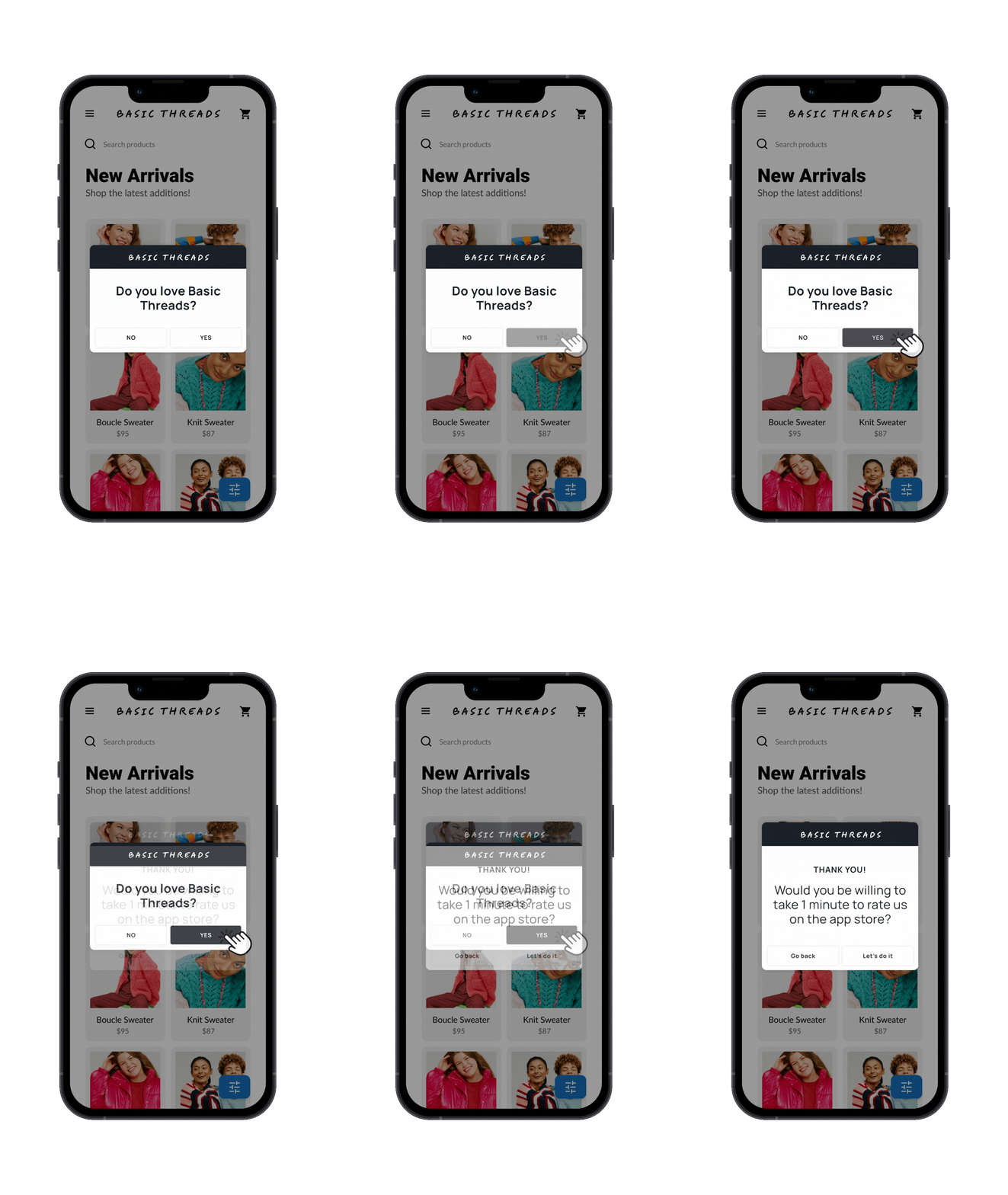
Reviews shape whether the next prospect downloads or scrolls past. A Love Dialogue — a simple "Do you love this app?" prompt — lets you read sentiment first, then route fans to the app store to leave a positive review and route critics to a quick survey instead of a public one-star.
Open-text feedback
The unstructured comments are where the real insight hides — and where manual analysis falls apart at scale. Purpose-built AI tools can analyze open-ended feedback across surveys, reviews, and social channels and surface the themes that matter, fast, so you're acting on patterns instead of anecdotes.
Quick start: a balanced mobile app feedback survey program
Pair an always-on sentiment prompt with periodic in-app surveys and a ratings flow. Sentiment tells you who's a fan, surveys tell you why, and the ratings flow turns the fans into five-star reviews. For many organizations, the most effective approach combines customer satisfaction surveys, feature request collection, app customer reviews, and open-text feedback analysis into a single continuous feedback program.
Key Features to Look for in an App Feedback Platform
Not all app feedback software is built the same. Some tools stop at collecting responses. A real app feedback platform collects, analyzes, and acts — and does it without forcing your engineers into every change. Here’s what separates a platform from a point tool.
The best app feedback platforms help teams do three things well: collect feedback in context, understand what customers are saying at scale, and take action quickly. When evaluating app feedback software, look beyond survey creation and consider how easily your team can turn customer feedback into product improvements, higher ratings, and better customer experiences.
Here’s what separates a platform from a point tool.
| Capability | What it means for your app feedback program |
|---|---|
|
Real-time collection |
Capture feedback the moment the experience happens, so issues surface within minutes of a release — not weeks later in a review. |
|
Mobile SDK integration |
Deploy inside iOS and Android apps without complex setup or heavy IT involvement. Build and launch programs yourself. |
|
Precision targeting & segmentation |
Reach the right customer at the right time using behavior, sentiment, and custom data — not blanket pop-ups. |
|
Triggered surveys & prompts |
Fire feedback requests off real actions and always-on contact buttons, so valuable input never slips away. |
|
Analytics dashboards |
Track sentiment over time, spot fans and at-risk customers, and see what’s changing across releases at a glance. |
|
Closed-loop feedback |
Follow up with the exact customers who gave feedback to show you acted — turning one-time input into loyalty. |
|
AI text analysis |
Purpose-built AI (Alchemer Pulse) turns overwhelming open-text feedback into clear, actionable themes at scale. |
|
Enterprise security |
End-to-end encryption, data residency, and SOC 2, GDPR, HIPAA, and FERPA compliance built in. |
Alchemer Digital delivers all of these in one mobile-first feedback platform — designed so busy product and CX teams can launch targeted programs in their apps and act on the results, fast.

Mobile App Feedback Use Cases Across Teams
Mobile app feedback isn’t owned by one department. The same in-app signals power very different wins depending on who’s reading them.
Product teams use feedback to improve features. Customer experience teams use it to understand sentiment. Marketing teams use it to drive engagement. Support teams use it to resolve issues faster. When feedback is connected across the organization, every team benefits from a clearer understanding of the customer experience.
Here’s how four different teams put Alchemer Digital to work.
Product & Technology Teams
Product success hinges on user experience. Alchemer Digital captures in-the-moment feedback and drives app ratings, turning user sentiment into product improvements that boost adoption and visibility.
- Improve app store ratings and search visibility
- Understand how releases impact customer satisfaction and engagement
- Design features based on real, timely user input
- Validate feature requests and product roadmap priorities
Customer Experience Teams
Product success hinges on user experience. Alchemer Digital captures in-the-moment feedback and drives app ratings, turning user sentiment into product improvements that boost adoption and visibility.
- Improve app store ratings and search visibility
- Understand how releases impact customer satisfaction and engagement
- Design features based on real, timely user input
- Validate feature requests and product roadmap priorities
Marketing Teams
Marketing wins when you know what customers feel and do in real time. Alchemer Digital turns digital behavior into targeted engagement, helping you reach the right people at the right moment.
- Build loyalty by recognizing and rewarding your most engaged customers
- Deliver campaigns and offers based on real behaviors, not guesses
- Strengthen brand perception with precise, relevant outreach
- Use customer sentiment to improve retention and lifecycle programs
Support Teams
Support is at its best when it's fast and informed. Alchemer Digital alerts you to customer issues as they happen, so you can act before they escalate.
- Respond instantly to at-risk customers
- Trigger follow-ups directly from feedback responses
- Use feedback trends to identify recurring support and usability challenges
- Use feedback trends to identify recurring support and usability challenges
Mobile App Feedback Examples and Outcomes
The most effective mobile app feedback programs help organizations improve customer satisfaction, increase app engagement, strengthen retention, and make smarter product decisions. These examples show how leading brands use mobile app feedback software to turn customer insights into measurable business results.
- Choose a use case below
c2c Railway
c2c Railway, a leading UK rail operator carrying 37.3 million passengers a year, sold tickets across five channels but was capturing almost no feedback from its iOS and Android apps — one of its most important sales channels. App store ratings dragged, skewed by a vocal minority. “We were blind to what people were doing on the app,” said Senior Business Analyst Enyidado Owusu. With Alchemer Digital, c2c deployed targeted in-app surveys and the Love Dialogue, routing happy customers to leave reviews and unhappy ones to a quick survey. They surfaced quick fixes — like removing a redundant postcode step from Apple Pay — within minutes of a release, and began comparing app feedback against other channels to confirm what to prioritize.

App ratings jumped from ~2.9 to 4.0 on Android and 4.5 on iOS. Feedback now surfaces issues within minutes of release, driving faster fixes and a smarter roadmap.StoryPoint Group needed faster insight into resident and family satisfaction across 150+ communities serving 14,000+ residents. With Alchemer, it reduced reporting time from weeks to days and enabled real-time satisfaction visibility — driving continuous experience improvements.
Pilot Flying J
Pilot Flying J relied on app store reviews to understand a diverse customer base across the U.S. and Canada — but reviews reflected the extremes, not the majority, and offered no way to follow up. The product team wanted to build features that aligned with what their most loyal customers valued most.
Using Alchemer, they deployed an in-app satisfaction survey segmented with Fan Signals™ to ask which app actions delivered the most value, then focused development on the highest-impact features.

87% of surveyed customers fell into the “most loyal” segment. 18,000+ survey responses in four weeks, with open-ended feedback adding even deeper insight into what mattered most.
Alkami
Alkami, a cloud-based digital banking provider, embeds Alchemer Digital in the apps of hundreds of financial institutions. Advantis Credit Union used it to find friction in their login experience, then worked with Alkami to let members view balances and recent transactions without logging in — exactly the experience members expected.

In one year, Advantis ratings rose to 4.7 in the App Store and 3.6 in the Play Store — a 31% iOS and 64% Android improvement. Average rating across Alkami clients reached 4.8.Supporting 16,000+ employees globally, Paychex needed a scalable way to measure employee engagement and training effectiveness. With Alchemer, they automated feedback collection and reporting, enabling HR and L&D teams to track engagement metrics and turn employee insights into data-driven decisions.
Dunkin'
Dunkin’, a powerhouse in the quick-service restaurant space, had to balance the needs of franchise owners with those of a loyal customer base — a balance that often slowed decisions about updating the mobile app. The team used Alchemer Digital to gauge customer sentiment and prioritize the improvements that mattered most.
With a 20% survey response rate, Dunkin’ gathered actionable insight straight from app users and acted on quick wins — like letting customers specify sprinkles on donuts or adjust ice levels in iced coffee. Small changes, driven by direct feedback, that made the experience noticeably better.

A 20% survey response rate, and 74% of mobile customers responded “Yes” when asked if they loved the app — strengthening retention and guiding faster, more intentional product decisions.
NCB Jamaica
National Commercial Bank Jamaica (NCB), one of Jamaica’s largest financial institutions, launched its mobile app in 2018 with a goal of improving accessibility and growing its digital presence. As adoption grew, so did the need for a secure, integrated way to communicate with customers, deliver critical updates, and gather feedback in real time. Security was paramount — and Alchemer Digital’s end-to-end encryption and compliance made it the right fit.
NCB put Alchemer to work across teams: in-app Prompts for marketing and communications, surveys for product and UX decisions, an NPS program to identify and reward promoters, and a Message Center for customer care. In one standout moment, a webinar that had drawn only 10 registrants jumped past 5,000 after the team promoted it with an in-app Prompt.

App store ratings climbed from 2 stars at launch to a consistent 4+ today. In-app Prompts saw 50–60% open rates (far above email), and the team drove a 92% improvement in user engagement in FY 23/24.
Turn App Customer Reviews into Actionable Insights
App store reviews are loud, public, and unavoidably skewed. Only the happiest and angriest customers tend to leave them, which means your rating reflects the vocal minority — not the experience of your typical customer. Reviews still matter for visibility and trust, but on their own they’re a blunt instrument.
App customer reviews provide valuable insight into how users perceive your mobile experience, but they rarely tell the full story. To understand what drives customer satisfaction, product adoption, and retention, organizations need to combine reviews with in-app feedback, surveys, and customer sentiment data.
The fix is turning that stream of feedback into structured insight.
Read sentiment, don’t just count stars. A 3.5-star average hides far more than it reveals. AI-driven analysis categorizes app customer reviews by topic and sentiment, so you see the why behind the score — which features earn praise, which spark frustration, and which themes are trending up or down. When sentiment is analyzed over time, teams can identify emerging issues before ratings decline and uncover the experiences that create loyal customers.
Categorize feedback at scale. When reviews, in-app survey responses, and social comments all land in one place, you can spot the issue that shows up across channels. If app users and web users are saying the same thing, you know it’s real — and you can prioritize it with confidence. Combining feedback sources helps organizations distinguish isolated complaints from widespread issues, making prioritization faster and more data-driven.
Reviews Tell You What Happened. Feedback Tells You Why. App store reviews are an important signal, but they are inherently reactive. In-app feedback allows teams to ask targeted questions, gather context, and understand customer motivations while the experience is still fresh. Together, reviews and feedback create a complete view of the customer experience—one that helps teams respond faster and make smarter product decisions.
Pro tip: software for customer reviews that only aggregates ratings leaves the hard part — understanding and acting — to you. Look for a platform that connects review sentiment to the rest of your feedback so insight leads directly to action.
How Mobile App Feedback Improves Customer Satisfaction
Mobile app customer satisfaction isn’t a mystery to solve once a year. It’s a signal you can read continuously — and improve deliberately. Every prompt, survey, and rating is a chance to understand where the experience shines and where it stalls. Here’s how feedback turns into satisfaction.
The most successful mobile apps don’t wait for customers to leave a negative review before taking action. They continuously collect feedback, identify friction points, and make improvements that strengthen the user experience over time. Mobile app feedback gives teams direct visibility into what customers are experiencing, making it easier to prioritize changes that have the greatest impact on satisfaction.
Understand friction points before they cost you
Customers rarely file a formal complaint. They just leave. In-app feedback surfaces the small frustrations — a clunky checkout, a confusing setting, an extra step that didn't need to exist — within minutes of a release. Fix the friction, and satisfaction follows. By identifying problems early, teams can prevent small usability issues from becoming larger retention challenges.
Improve onboarding
The first few sessions decide whether a customer sticks. A well-timed mobile app customer satisfaction survey early in the journey tells you where new customers get stuck, so you can smooth the path before they give up. Feedback collected during onboarding often reveals gaps in product education, confusing workflows, or unmet expectations that can significantly impact long-term engagement.
Drive feature adoption
Shipping a feature isn't the same as getting it used. Feedback shows you whether customers understand a new capability, value it, and can find it — so you can refine, reposition, or guide adoption with targeted prompts. Understanding why customers do—or don't—adopt new features helps teams improve the product experience while increasing the return on development investments.
Build customer loyalty
People stay where they feel heard. When you ask for feedback, act on it, and close the loop, you turn a transaction into a relationship. That's how a satisfied customer becomes a loyal one — and a loyal one becomes an advocate. Closing the loop is one of the most powerful drivers of customer loyalty. When customers see that their feedback leads to real improvements, they become more engaged and more likely to continue using the app.
Increase mobile app engagement
Mobile app engagement improves when experiences become more relevant, intuitive, and valuable to customers. Feedback helps teams understand which features drive usage, which experiences create frustration, and which moments deserve additional investment. The result is a more engaging app experience that encourages customers to return more frequently.
Create a continuous improvement cycle
The strongest mobile app feedback programs create an ongoing cycle of listening, learning, and improving. Teams collect feedback, identify patterns, implement changes, measure results, and repeat the process. Over time, this continuous approach helps improve customer satisfaction, strengthen retention, and support sustainable mobile app growth.
Why Alchemer is the Best Mobile App Feedback Platform
Why do teams choose Alchemer Digital? Unlike traditional survey tools, Alchemer Digital is designed specifically for digital experiences. Teams can collect mobile app feedback, monitor customer sentiment, improve app customer reviews, and trigger real-time actions from a single platform.
Whether you’re looking to increase mobile app engagement, improve customer satisfaction, drive feature adoption, or boost app store ratings, Alchemer helps connect customer feedback directly to the decisions that shape your product experience.
What makes Alchemer different? Many app feedback platforms stop at collecting responses. Alchemer Digital combines in-app feedback, sentiment measurement, ratings programs, workflow automation, and enterprise-grade integrations into a single mobile-first solution. This allows product, customer experience, marketing, and support teams to work from the same customer insights rather than disconnected data sources.
The result is faster issue resolution, smarter product decisions, higher customer satisfaction, and stronger mobile app growth.

| Capability | Alchemer Advantage |
|---|---|
|
Flexible in-app survey deployment |
Build and launch targeted feedback programs inside your mobile apps, both Android and iOS, without complex setup or coding. Make surveys engaging with rich text, images, and custom formatting, and collect feedback anytime with always-on prompts and contact buttons. |
|
Mobile-first by design |
Alchemer Digital is built for the way people actually use their phones — conversational, in-the-moment, and personal. Engage customers right inside your app, exactly where they are in their digital journey, not with a generic web survey bolted onto a small screen. |
|
Deeper targeting |
Pinpoint exactly who to reach and when by blending in-app behavior, sentiment, and custom data. Precision targeting means higher response rates and feedback from the customers who matter most — including your most loyal, high-value app users. |
|
Workflow automation and integrations |
Insights only matter if they spur action. Alchemer Digital routes feedback into the tools your teams already use, fires alerts to the right people, and triggers follow-ups automatically — so a survey response becomes a closed loop, not a spreadsheet row. |
|
Enterprise security and support |
Your security and compliance needs are covered: end-to-end encryption, data residency and isolation, and SOC 2, GDPR, HIPAA, and FERPA compliance. Plus a support team that’s with you from onboarding through advanced mobile targeting strategy — so you see measurable results faster. |
Need more than a Digital solution?
Mobile app feedback is one channel in a complete feedback program. Alchemer connects the rest, so insights from your app don’t live on an island.
Survey enables organizations to collect, analyze, and act on feedback faster than ever before, driving real impact without the complexity or cost of most enterprise solutions.
Capture and act on customer feedback directly within your apps and websites, reaching users at the perfect moment in their journey.
Go from feedback to insight to action in one platform. Alchemer’s AI capabilities help you understand what customers are saying, to respond at scale, and fix issues before they grow.
Get reliable, high-quality market research with Alchemer Research Solutions.












What Customers are Saying About Alchemer’s Mobile Feedback Software



See how Alchemer Digital helps your team collect in-app feedback, lift ratings, and turn user sentiment into better product decisions.
Related Resources

In-app feedback 101: How to collect, analyze, and act on mobile feedback
This blog breaks down the most common questions about in-app feedback, so product, CX, support, and....

Customer Feedback is the Digital Era
How brands can stay customer-obsessed in a new and ever-changing digital business environment...

Your App Has Changed. Has Your Feedback Strategy?
Marketing involves many moving parts — creative, media, audience segmentation, analytics, operations — but a crucial...
Mobile app feedback is the input customers share inside your app about their experience — through in-app surveys, ratings prompts, sentiment signals, feature requests, and open-text responses. Unlike app store reviews, which capture only the extremes, in-app feedback reaches the quiet majority of customers in the moment, so you understand the full picture and can act before issues turn into churn or low ratings.
Mobile app feedback software collects, analyzes, and acts on feedback gathered inside iOS and Android apps. The strongest tools are platforms — unifying surveys, ratings, sentiment, and open-text analysis in one system, with targeting, dashboards, and integrations that turn responses into action, rather than stitching together disconnected point tools.
Alchemer Digital captures more than survey responses. It collects ratings, sentiment signals, and in-app interactions, lets you target the right customer using behavior and custom data, and routes insights into the systems your teams already use — all without heavy engineering lift. It’s mobile-first, well supported, and built to drive action, not just collect data.
Yes. Alchemer Digital captures feedback across both mobile apps and websites, so you get a connected view of customer sentiment across your digital journey rather than a single channel.
By reading sentiment first. A Love Dialogue asks “Do you love this app?” and routes fans to leave an app store review while sending unhappy customers to a private survey instead of a public one-star. Customers like c2c Railway and Advantis Credit Union saw ratings climb significantly using this approach.
Fast. Alchemer Digital is built for busy teams to launch targeted feedback programs in their apps without complex setup, coding, or heavy IT involvement — and a support team helps you get to measurable results sooner.
No. While you can run surveys, Alchemer Digital also captures ratings, sentiment signals, and other in-app interactions, giving you a richer, more connected view of your customers.
Mobile app feedback is feedback collected directly inside an app through surveys, ratings prompts, sentiment signals, feature requests, and other in-app interactions. App store reviews are public reviews left in app marketplaces like the Apple App Store or Google Play. Mobile app feedback provides richer context and reaches more users, while app store reviews offer public visibility into customer sentiment. The strongest feedback programs use both. .
The best time to ask for mobile app feedback is immediately after a meaningful interaction, such as completing onboarding, making a purchase, using a new feature, resolving a support issue, or reaching a milestone. Triggering feedback requests in context helps increase response rates and improves the quality of responses.
Most organizations collect a combination of in-app surveys, Net Promoter Score (NPS), Customer Satisfaction Score (CSAT), Customer Effort Score (CES), feature requests, app store reviews, ratings, and open-text feedback. Combining multiple feedback sources provides a more complete view of customer sentiment and customer satisfaction.
Mobile app feedback helps teams identify friction points, improve onboarding experiences, increase feature adoption, and respond to customer concerns before they impact retention. By continuously collecting and acting on feedback, organizations can improve customer satisfaction and create better app experiences over time.
Yes. Mobile app feedback helps organizations understand customer sentiment before it appears publicly in app store reviews. Many teams use ratings prompts and sentiment-based workflows to encourage satisfied customers to leave reviews while routing dissatisfied customers to private feedback channels where issues can be addressed directly.
As you compare app feedback tools and platforms, consider:
Can the platform collect feedback inside both iOS and Android applications?
Can surveys be triggered by customer behavior and app events?
Does the platform support customer satisfaction surveys, NPS, CSAT, and feature request collection?
Can feedback be routed automatically to product, support, or customer success teams?
Does the platform provide AI-powered analysis for open-text feedback and app customer reviews?
Can teams launch and update feedback programs without relying heavily on engineering resources?
The answers to these questions often determine whether an app feedback platform becomes a strategic source of customer insight or simply another survey tool.
Traditional feedback programs often identify problems after customers have already left a negative review or stopped using the app. Real-time feedback collection helps teams identify friction, understand customer sentiment, and respond while the experience is still fresh. That speed can have a direct impact on customer satisfaction, retention, and app store ratings.