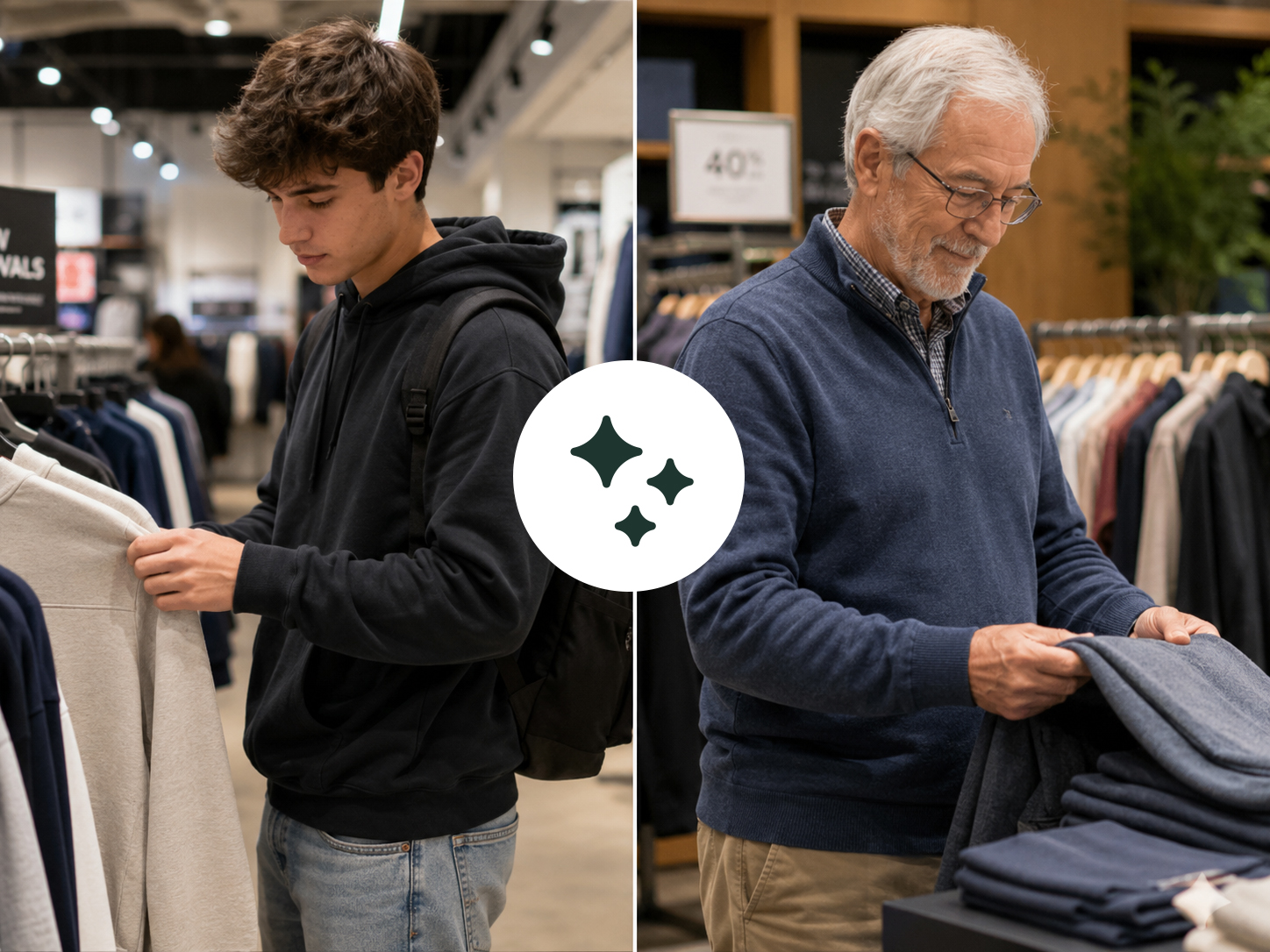
A 25-year-old and a 65-year-old can buy the same product from the same retailer in the same week and take completely different routes to get there. One of them asked an AI assistant first. The other has never tried.
According to Alchemer’s 2026 Retail Report: Retail AI Adoption Outpaces Consumer Trust, 74% of shoppers aged 18 to 29 have used AI to research a purchase, compared with 20% of shoppers 61 and older. That 54-point gap is the widest behavioral split in the dataset, and it reshapes everything from research to reassurance.
TL;DR — key takeaways
- 74% of 18-to-29-year-olds have used AI to research a purchase, versus 20% of shoppers 61 and older, according to Alchemer’s 2026 Retail Report.
- The youngest group is nine times more likely than the oldest to have discovered their most recent purchase through an AI tool.
- Privacy is the top AI concern for every age group, from 32% among 18-to-29-year-olds to 38% among 45-to-60-year-olds.
- Younger shoppers worry more about output quality: 27% flag fake or AI-generated content, roughly double the rate among shoppers over 45.
- 12% of shoppers 61 and older say nothing about AI concerns them, compared with under 3% of 18-to-29-year-olds.
How does AI shopping adoption differ by age?
Dramatically, and it doesn’t taper gently. Here’s the contrast at the two ends of the curve, per Alchemer’s 2026 Retail Report:
| AI attitude | Shoppers 18–29 | Shoppers 61+ |
|---|---|---|
| Have used AI to research a purchase | 74% | 20% |
| Flag fake or AI-generated content as a concern | 27% | About half that rate |
| Flag biased recommendations as a concern | 21% | About half that rate |
| Say nothing about AI concerns them | Under 3% | 12% |
For shoppers under 30, AI is already part of how retail works. Most shoppers over 60 haven’t tried it once. Any AI feature you launch will land as table stakes for one group and as an unfamiliar detour for the other.
Do younger and older shoppers worry about different things?
They share the top worry and split on everything after it. Privacy is the leading AI concern for every age group, from 32% among 18-to-29-year-olds up to 38% among 45-to-60-year-olds. That’s the one universal.
Past that, the groups diverge in a telling way. The shoppers actually using AI are the ones scrutinizing what it produces: 27% of 18-to-29-year-olds flag fake or fabricated content and 21% flag biased recommendations, roughly double the rates among shoppers over 45. Older shoppers voice fewer specific objections and are far more likely to say nothing about AI bothers them at all (12% of the 61-plus group versus under 3% of the youngest).
It’s worth naming what that means. Older shoppers aren’t hostile to AI. They’re unfamiliar with it, and their concerns will sharpen as adoption grows.
A 22-year-old and a 65-year-old aren’t the same shopper. Alchemer Pulse reads open-text feedback for themes and sentiment by age, channel or location, so a blended average stops hiding the difference. Explore Alchemer for Retail →
Which shopper segment is more price sensitive?
The older one, which is the opposite of what the AI numbers might suggest. Price and affordability as a top purchase factor climbs from 14% among 18-to-29-year-olds to 30% among shoppers 61 and older. So the group least engaged with AI is the group weighting price most heavily, and the group most engaged with AI is the group most skeptical of what it hands them. Neither segment is easy, and neither responds to the same message.
How should retailers segment their AI strategy?
Build two plans from the same platform:
- For younger shoppers, lead with transparency and control. They’re already in the AI flow and judging its output. Label AI-driven answers, make personalization opt-in and show what a recommendation is based on.
- For older shoppers, don’t push AI. Let it work quietly. Use AI to smooth the experiences they already trust, like faster service recovery and accurate listings, instead of putting an assistant between them and a purchase.
- Keep the value story clearest for the 61-plus group. They weight price most heavily and are the most likely to pull back spending.
- Segment your reporting, not just your messaging. A blended satisfaction score averages two very different shoppers into one number that describes neither.
One strategy across both segments over-serves whichever group you designed for and quietly under-serves the other. Two plans cost more thought, not more platform.
Want the full report? Read the complete 2026 Retail Report: Retail AI Adoption Outpaces Consumer Trust for the full age breakdowns across AI usage, concerns, discovery and reviews.
Methodology: Alchemer’s Research Solutions team surveyed 1,002 U.S. shoppers across age groups, genders and shopping channels about their retail experiences and research habits in 2026.
FAQ
Q: How many younger shoppers use AI to shop?
A: 74% of shoppers aged 18 to 29 have used AI to research a purchase, compared with 20% of shoppers 61 and older, according to Alchemer’s 2026 Retail Report.
Q: What is the biggest AI concern across age groups?
A: Privacy, which leads for every age group, ranging from 32% among 18-to-29-year-olds to 38% among 45-to-60-year-olds.
Q: Are older shoppers opposed to AI in retail?
A: Mostly they’re unfamiliar with it. 12% of shoppers 61 and older say nothing about AI concerns them, versus under 3% of the youngest group, per Alchemer’s 2026 data.
Q: Should retailers use one AI strategy for all shoppers?
A: No. Younger shoppers need transparency and control over AI features, while older shoppers respond better to AI working quietly behind experiences they already trust.