Your online reviews are already doing work for you. They’re shaping search rankings, building trust with buyers you haven’t met yet, and telling you exactly how customers describe your value. The opportunity is what happens next: most teams stop at monitoring and responding, when those same reviews could be fueling content, ads, sales conversations, and competitive research.
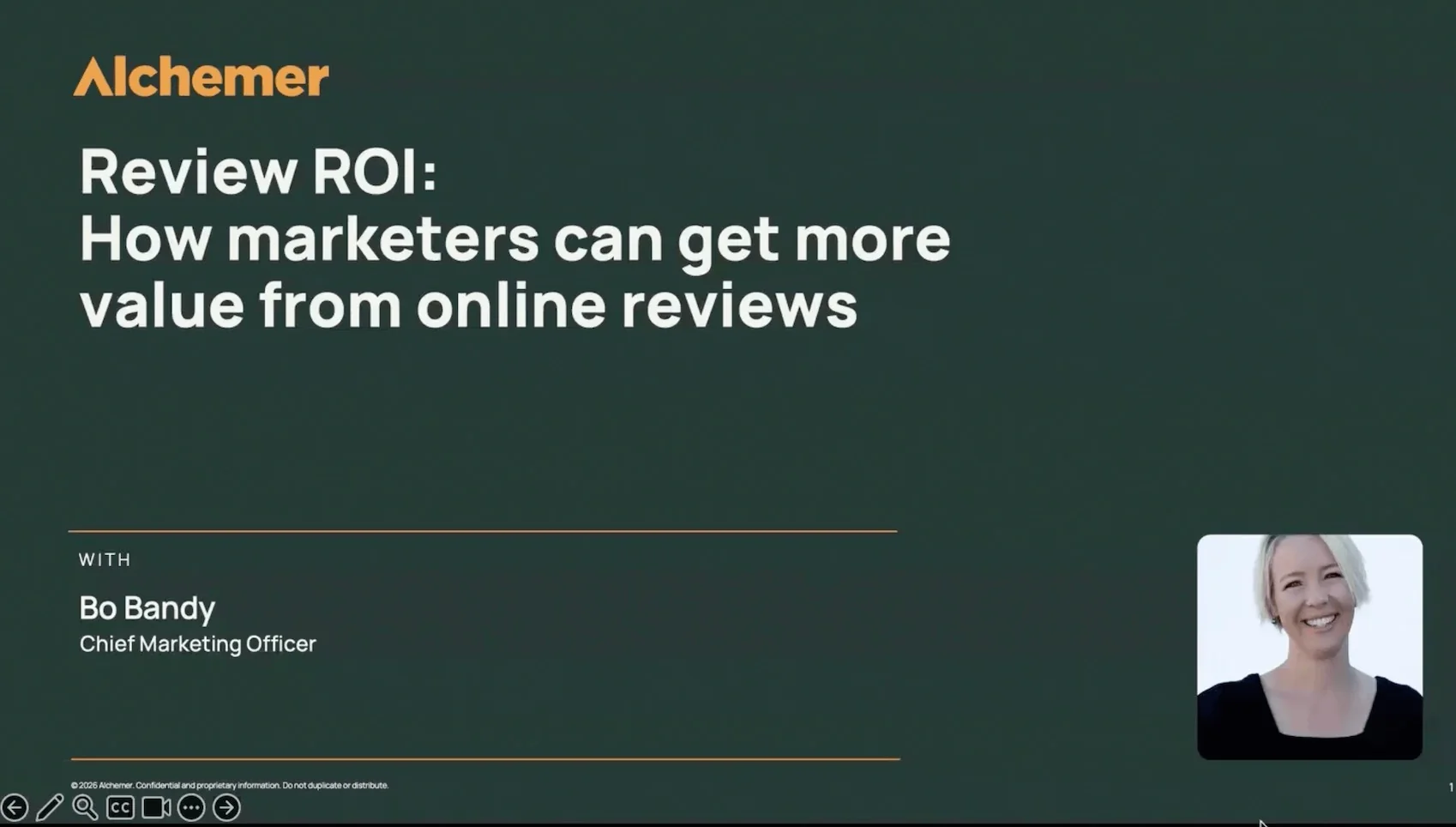
That’s the gap Alchemer CMO Bo Bandy set out to close in our recent webinar, “Review ROI: How marketers can get more value from online reviews.” Bo is candid about where she stands: reviews are one of the most powerful marketing tools available to a team, and one of the most underused. This session isn’t about collecting more reviews. It’s about getting more out of the ones you already have.
Watch the on-demand recording or read on for the highlights.
Reviews impact every stage of the buying journey
Bo starts by walking the sales funnel, stage by stage, because the value of reviews changes depending on where a buyer sits.
At the top, reviews are a visibility play. Review volume, recency, sentiment, and response rate all feed Google’s local ranking signals, which means your reviews help decide whether you show up in map and local search at all.
In the middle, they’re a trust signal. 86% of consumers use Google Business Profiles to evaluate local options, and 90% read reviews before visiting a business. The flip side matters just as much: 94% say a bad review has talked them out of a business entirely.
Further down, reviews start moving money. Consumers spend up to 49% more with companies that respond to their reviews. And after the sale, reviews turn into operational intelligence. Sentiment patterns across locations point to staffing gaps, process breakdowns, and product friction well before those problems reach a churn report. Silence carries a cost, too. 57% of consumers say they’d avoid a business that never responds to feedback.
Where marketing gets the most value
Reviews tend to live with one person or one team. Bo’s argument is that almost every function in a marketing org has a use for them, from the SEO lead to the content writer to the person building the sales deck.
A few of the plays Bo covers:
- Free message testing. Reviews tell you what customers value and what frustrates them, in their own words. Mine that language before you write your next campaign brief instead of guessing at it in a messaging workshop.
- Search visibility. Reviews drive unpaid search traffic and clicks, and the keywords and topics inside them can shape both your SEO and paid strategy. It’s arguably the highest-ROI channel most teams underinvest in.
- Social proof that isn’t yours. 79% of people trust online reviews as much as a personal recommendation. Put real quotes on landing pages, product pages, and social, where a claim from your brand would land softer.
- Sales enablement. Give reps quotes matched to the industry, use case, or objection in front of them. “Here’s what a customer like you said” outperforms anything a rep can write about your product.
- Demand generation fuel. Star ratings and review snippets in Google, Meta, and display ads. A batch of strong reviews cut into a testimonial reel. A review of the week dropped into a nurture sequence.
- Competitive intelligence. Your competitors’ reviews are a running list of their weaknesses and of the things their customers wish they had. Read past the star rating and into the specific pain points.
- Content and case study sourcing. Recurring confusion or unanswered questions in reviews are content briefs waiting to happen. And a customer who left you a glowing review has already self-identified as a fan, which makes the case study ask a much easier conversation.
Two questions from the audience
One attendee asked the question every marketer is thinking: if we’re already spending our time responding to reviews, how do we find time to do more with them?
Bo’s answer was practical. If you’re managing high review volume without a platform, start there. Alchemer offers AI that drafts responses under rules you set, so your team approves rather than writes. Alchemer has found that 93% of AI-drafted responses get approved without a single edit. Even with a human reviewing every one, that’s hours back.
The second question was about permission. Can you use a customer’s review in your marketing? Bo’s take: reviews posted on public sites give you more latitude than survey responses, which you shouldn’t use without asking. But latitude isn’t a free pass. Don’t run an ad naming a person or company without approval, and consider dropping names and locations when the quote works fine without them. If a review is headed into a video or a social campaign, give the customer a heads up.
Watch the full webinar
If your review program currently ends at “we responded,” this session will give you a longer list of things to do with the data you’re already sitting on. Watch the on-demand recording of “Review ROI: How marketers can get more value from online reviews” here.
Want to talk through how Alchemer can help you act on reviews at scale? Reach out to our team.