Meet The Worst Survey in the World

Turns out the Worst Survey in the World is more fun than a typical survey.
Good Gamer Group (GGG) deliberately built The Worst Survey in the World to look, sound, and feel like the worst survey you’ve ever taken. While it started as a challenge, it turned into a real test of whether a survey can be fun without sacrificing quality.
Here’s the story of how a panel, a platform, and a philosophy led to an experiment that may change how the market research industry thinks about survey design.
About Good Gamer Group: Where Real Gamers Power Better Research
Interpret is a global consumer insights agency that specializes in understanding people at play across gaming, entertainment, consumer tech, social media, sports, fitness, toys and other forms of leisure. Interpret has built an active community of passionate, authentic participants in Good Gamer Group (GGG), a proprietary gaming market research panel comprised of 80,000 individually verified gamers. Founded in 2019, Good Gamer Group (GGG) helps video game companies understand their players through market research. Its panels are made up of real gamers who have hundreds of hours of play under their belts.

Level One: Build an Audience Panel
A market research panel is a group of people who’ve agreed to share their opinions on an ongoing basis. Researchers recruit members, invite them to take surveys, and reward them with an incentive for their time. Then they keep coming back with new studies on other topics. Done well, a panel gives companies a fast way to hear from exactly the people they want to reach.
Low Health Bar: What's Draining Modern Market Research
Before we get to The World’s Worst Survey, we need to talk about what inspired it.
Ask anyone who runs a panel and you’ll hear the same complaints:
- Bots and fraud rings get more sophisticated every year; some running through data centers with unlimited IP addresses to capture survey incentives at scale.
- Respondents are asked to retype their age, gender, and location on every single survey. For members who’ve been part of a panel for years, that repetition can feel like the panel doesn’t know them. Every extra field is a chance to lose someone before they ever reach the questions that matter.
- Survey Fatigue. A growing number of people are simply tired of generic surveys. Once someone decides a survey isn’t worth their time, they either rush through it for the incentive or skip.
Some of these issues come down to the size of the panels and lack of engagement. It’s become common for panels to market themselves on size: a million members, then ten million, then a billion. But a big number doesn’t tell you how many of those members are active, engaged, and a real fit for your study. An inflated panel creates a familiar chain reaction: fewer qualified people respond, so panels overcompensate by sending thousands of invitations to backfill a study, disqualifying the vast majority of people who click through. Do that enough times and the panel’s best, most engaged members start to churn, because the surveys landing in their inbox stop feeling relevant to them.
The Good Gamer Group Philosophy: Quality Over Quantity
Jesse Divnich, founder and president of Good Gamer Group and Good Entertainment Group, has seen this firsthand. Jesse observes, “If I do the math, the vast majority of that billion isn’t actually taking anything. They signed up. Great. But they’re not active members.” From the beginning, Jesse and his team built the panel to match real project needs instead of chasing headline numbers. If a study needed 20 people, they recruited 20 people. Nearly eight years and close to 4,000 studies later, that same discipline has grown their panel to close to 80,000 verifiably authentic gamers.
Because GGG tracks members’ gaming activity, survey invitations are personal enough that members actually respond. That reflects what’s always been central to the GGG philosophy: building a community where gamers feel heard, validated, and rewarded for their honest input.
Cheat Code: Customizable Surveys with Alchemer
A targeted and engaged audience needs to be paired with a thoughtfully designed survey. As Jesse explains, “A great survey respects participants’ time, asks only what matters, and builds trust through thoughtful design. Even when someone doesn’t qualify, the experience should leave them willing to return. The care we put into that experience shapes the quality of the responses we get back.”.
For seven years, Good Gamer Group has used Alchemer as its survey engine. Alchemer’s customer feedback and intelligence platform draws on 20 years of survey and market research expertise, and it’s flexible enough to adapt to how each team works. GGG utilizes Alchemer’s CSS capabilities to customize the survey UI: reskinned checkboxes, radio grids, ranking questions, and drag-and-drop interactions, all styled to match their brand, colors, and visual identity throughout.
By customizing its surveys to better engage participants, GGG achieved average survey completion rates above 85%. Because gamers already love talking about their gaming habits, response quality on open-ended questions improved once the visual experience finally matched what members expected.
The GGG tam utilizes additional security measures to help prevent survey fraud. Using Alchemer’s webhooks and scripting, they integrated a third-party tool that scans IP addresses and devices to catch fraud from data centers and bot farms. When fraudsters started using data centers to get unlimited IP addresses, the team added SMS verification, the same text-message code many apps use to confirm a real person.
Synced Up: How a Connected Platform Makes Survey-Taking Easy
Members told the team they were frustrated to have to answer demographic questions every single time, so Good Gamer Group connected its customer relationship management (CRM) system directly into Alchemer.
With Alchemer’s integration capabilities, the team was able to pull respondent information straight from the CRM, skipping the identifying questions entirely and dropping them right into the part of the survey that matters. Additionally, GGG connected its incentive platform, Tremendous, so a gift card is ready and sent the moment a member finishes.
That kind of automation turned the entire process—from survey to reward—into something fast enough to fit into a five-minute break. The process is secure enough to keep fraud out and reliable enough that members trust the payout is coming, which is a big part of why they keep coming back.
“Once we connected the survey platform, our CRM, and Tremendous, it was off to the races…That was a big moment. There’s a lot of kind of watershed moments within Good Gamer Group, but really that propelled growth”
— Jesse Divnich, President, Good Entertainment Group / Good Gamer Group
Key Outcomes: GGG Achievement Unlocked
That combination of a modern, on-brand experience, the right-sized panel, and a survey flow with the friction engineered out, shows up directly in the numbers GGG tracks.
- Full studies fielded in 24 hours. Even for samples of 500 to 1,000-plus respondents, Good Gamer Group can field and close an entire study in a day.
- 60% to 70% of completes in the first hour. Because members get an SMS or mobile notification and already know they’re likely to qualify, they respond fast.
- Fewer than 10% of respondents were disqualified. Precise targeting means most people who start a survey were already a fit for it.
- Less invites per completes – 150 invitations per 100 completes. A traditional panel or client CRM typically has to send around at least 5,000 invitations to land the same 100 completes.
Game Over for Boring Surveys: Inside Good Gamer Group's Worst Survey Ever Built
With a right-sized, highly engaged panel, a branded interface, and a frictionless user process, one big problem exists: nobody wants to take a survey. Jesse and the GGG team have always been thoughtful about building well-programmed surveys with seamless experiences. But a traditional survey is still a traditional survey, and people get bored, lose interest, or tire of the same types of questions.
This sticking point came to a head in a conversation between an Executive Vice President at Interpret, and Jesse. The EVP didn’t think Alchemer was flexible enough to handle a survey concept she had in mind, questioning how far a survey could really be pushed.
Jesse took it as a challenge. He set out to build a survey gamers would actually want to take, and to prove that Alchemer was flexible enough to make it happen.
“I said to our EVP, ‘I can make Flappy Bird in Alchemer.’ Then I thought, wait, I will make Flappy Bird in Alchemer.”
— Jesse Divnich, President, Good Entertainment Group / Good Gamer Group

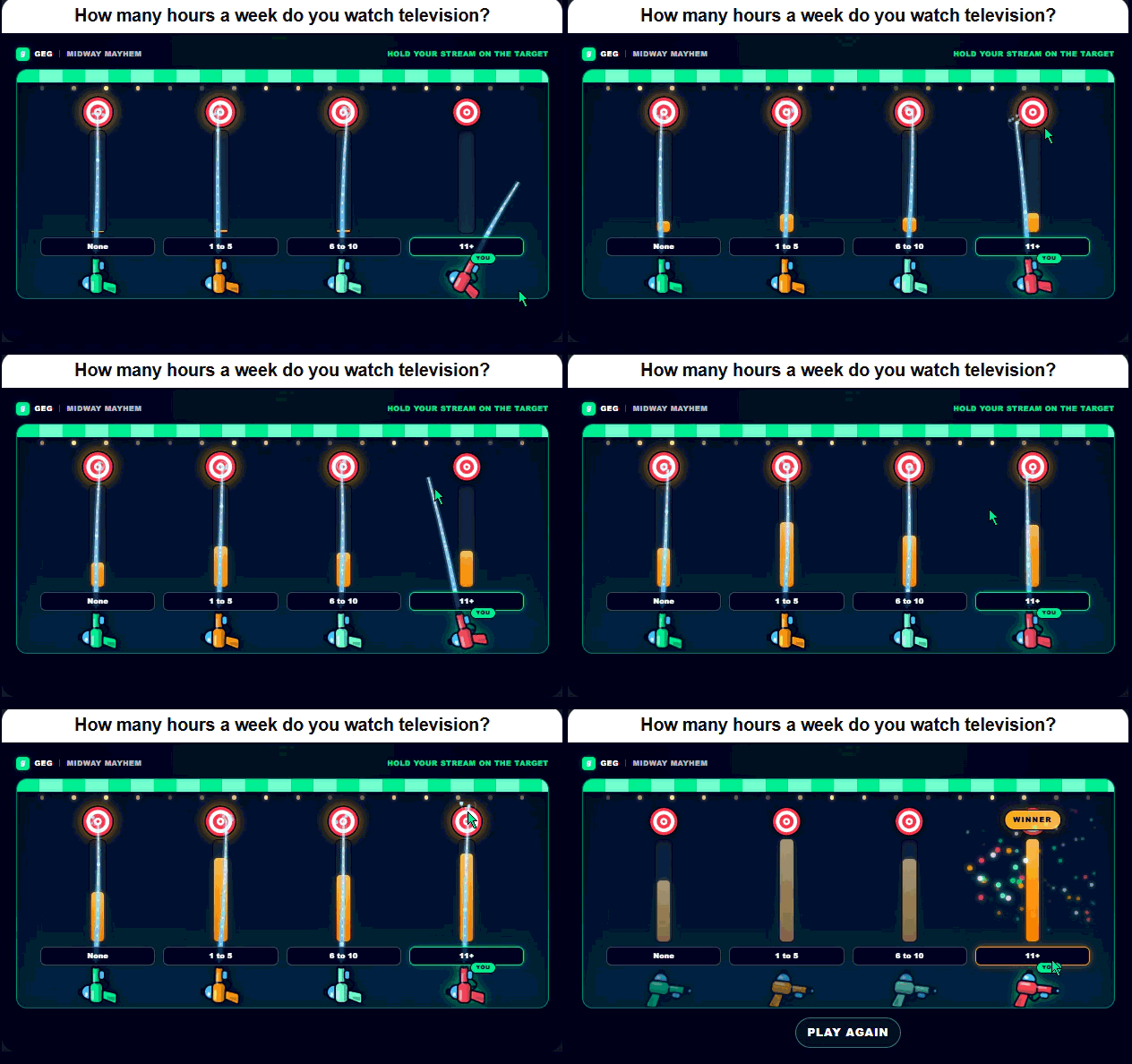
Flappy bird was only the beginning Using AI-assisted coding on top of Alchemer’s action items and scripting, Jesse and his team worked through the standard survey question types one at a time and reimagined each one as a game: a multi-select checkbox reworked into a claw machine, a numeric entry turned into a spinning dial, a rating scale rebuilt as a basketball free-throw, a screener question wrapped in a carnival water-gun game, and of course flappy bird itself, rebuilt as a way to answer a simple yes-or-no question.
The survey trolled the survey taker and was gloriously bad for market research but fun to take anyway. The team loving started calling it, The Worst Survey in The World, a name designed to be just as provocative as the survey itself. Nobody expects a survey to brag about being bad, but that’s exactly the point. The title sparks curiosity and practically dares people to click. Once they do, turns out to be equally frustrating and fun.

The survey didn’t stay a joke for long. One of Jesse’s user testers pointed out something nobody had planned for: strip away the joke and some of these were genuinely better ways to ask a real question. A slider disguised as a game was still a slider. A basketball hoop was still collecting a rating. The novelty had accidentally uncovered a design idea worth taking seriously.
“That’s when it went from being this jokey, ha-ha thing to being something that could actually change how people think about survey design.”
— Jesse Divnich, President, Good Entertainment Group / Good Gamer Group
What's Next
GGG’s near-term plan is to build a small, unexpected moment of fun into most of its surveys going forward. The team is targeting the questions people answer on autopilot, with the long-term goal of proving out, with real data, whether a little fun measurably improves completion rates and lowers partials.
The GGG team could use this as a competitive differentiator and a proprietary approach that helps them win more clients. Instead, they want to share what they’ve learned about building on top of Alchemer with webhooks and lightweight scripting. They’re not proposing every survey should look like a video game, but GGG recognizes that most industries would benefit from putting more thought into designing questions that make a survey feel more engaging and less like a chore. Jesse says, “As silly as it sounds, ideas like this exist because they spark new ones. I’d love for other people to build on this and just do their own thing.”
Whether the audience is gamers, kids, or patients sharing sensitive health information, GGG sees the same opportunity: make surveys feel more thoughtful, approachable, and human. in any industry, a well-designed experience built with the audience in mind helps build trust. That means researchers should understand who they’re surveying and think creatively about how to make participation feel engaging, relevant, and worth seeing through to the end. It’s the same idea behind GGG’s broader philosophy: a community where participants feel understood, valued, and motivated to engage ultimately leads to better research.
For a team that started by asking why survey platforms don’t look like anything else gamers use, that’s exactly the point: a little fun isn’t a distraction from good research, it might be the thing that makes people want to partake in the first place. And for GGG, Alchemer has been flexible enough to prove it.
Related Content

How Lids turned brand insights into business impact
