- Resource Library
- Research Report
- The Ultimate Guide to Closing the Feedback Loop
The Ultimate Guide to Closing the Feedback Loop
How Alchemer helps you turn feedback into action that customers can see
Introduction
You’ve collected the feedback. Maybe a lot of it. So here’s the question that matters: did anything change because of it? And did the customer ever find out?
That second part is where most feedback programs quietly fall apart. Surveys go out, responses come in, a dashboard lights up, and then… silence. The customer who took the time to tell you something never hears back. The insights from that feedback never reach the team that could act on it. The feedback loop stays open.
This guide is all about closing those feedback loops. We’ll walk through all four stages of the feedback cycle, from collecting feedback at the right moment to telling customers exactly what you did with it. Let’s dive in.
What Is Closed-Loop Feedback?
Closed-loop feedback is the practice of capturing feedback, analyzing it, taking action, and following up with the customer to show them their input led somewhere. It’s a loop because it comes back around to the person who started it.
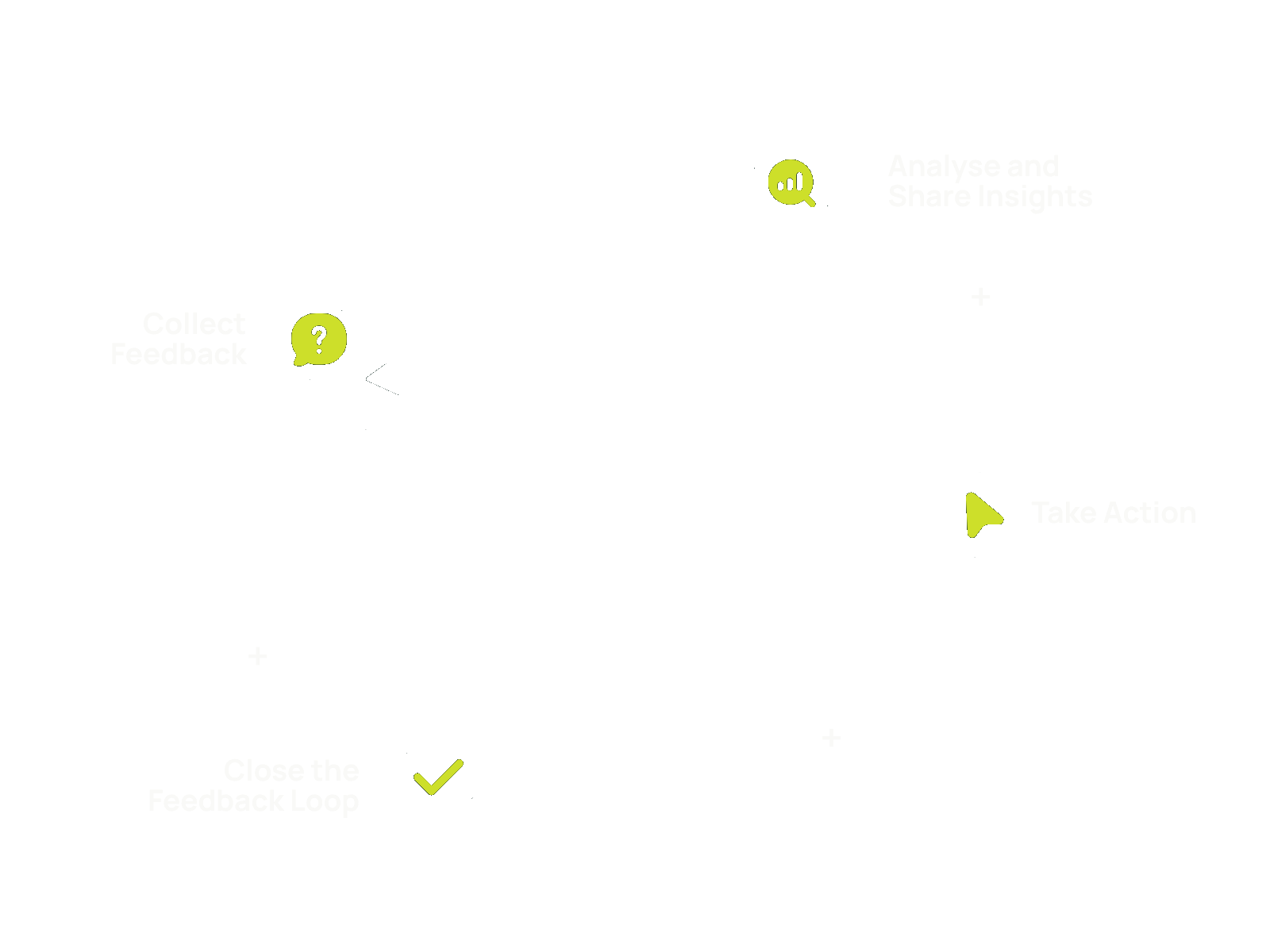
The four stages of closed loop feedback:
Collect — Gather feedback at the moments that matter: post-purchase, in-app, review sites, after a support interaction, after a stay.
Analyze — Make sense of what customers are actually telling you, at scale with AI-powered analysis and dashboards.
Act — Route the right insight to the right team so things actually change, whether that’s in product, operations, the frontline, or the executive suite.
Close the loop — Follow up with the customer to tell them what you did, why you did it, and what’s next.
Most teams are good at the first stage and lose steam somewhere around the third. The payoff lives at the end, companies that close the loop see stronger retention, higher response rates over time (people answer when they believe it matters), and a measurable lift in loyalty. When customers know their feedback gets acted on, they keep giving it. That’s the flywheel.
Step 1: Collecting Feedback
Good feedback starts with good timing. Relevance beats volume every time. A short, well-placed survey at the right moment will tell you more than a long one blasted to everyone.
The first job is picking the right moments. Ask right after the experience you want to understand, while it’s fresh, whether that’s post-purchase, post-support, post-stay, or mid-onboarding. The closer the question sits to the moment, the more honest and specific the answer. And match the channel to that moment, too. In-app micro-surveys catch customers where they already are, email follow-ups give them room to reflect, SMS is fast, and intercepts meet people in the flow. Use the channel that fits instead of forcing every question through the same pipe.
Then there’s the question itself. NPS (Net Promoter Score), CSAT (Customer Satisfaction Score), and CES (Customer Effort Score) each earn their place in different spots: NPS for overall loyalty, CSAT for a specific interaction, CES for friction. Pair a metric with one open-ended question, and you get both the score and the story behind it. Keep the whole thing short, because every extra question costs you a response. A good test for each question is to name the decision someone could make based on the answer. If you can’t, cut it.
A few common mistakes are worth sidestepping:
- Surveying the same people too often.
- Asking about things you can’t act on.
- Ignoring the customers who didn’t respond. Silence is data too.
Interaction Response Targeting
Step 2: Analyze and Share Insights
Raw responses aren’t insight. A thousand open-ended comments sitting in a spreadsheet is just homework nobody wants to do. The job here is turning that pile into themes a person can actually act on.
Start by moving from individual responses to patterns. What are customers really telling you, not one of them but fifty of them saying versions of the same thing? That repetition is the signal. Purpose-built text analytics read thousands of open-ends and surface those themes in minutes instead of weeks, which is the difference between reacting this quarter and reacting next year. A global automotive research firm used Alchemer to condense six months of analysis across more than 300,000 open-text responses down to a matter of hours.
Once you have themes, get specific. “Customers are unhappy” isn’t actionable, but “enterprise customers in the West region are frustrated with onboarding speed” is. Slice by tier, journey stage, product line, region, or persona until the insight points somewhere. Then tie those themes to the numbers that move the business: revenue, churn risk, CSAT. When a theme has a dollar figure or a retention impact attached, it stops being an opinion and becomes a priority.
Finally, share each insight in the format the audience will actually use. Executives want a dashboard, frontline teams want an alert, and product wants a ticket. Same insight, different package. The thing to avoid is the insights graveyard, that folder of beautiful reports nobody opens. A report no one reads is feedback you collected for nothing.
Industry Spotlight: Healthcare
According to Alchemer’s Healthcare Patient Experience Report, 98% of patients say feedback is easy to give. Only 51.5% see anything change because of it. Healthcare providers have the front end of the loop solved. Patients are willing, and the channels work. The break happens at follow-through: 73% of patients get a prompt acknowledgment after submitting feedback, but only half see clear action taken. Another 18% aren’t sure anything happened, and 12% are certain nothing did. That 22-point drop from “we heard you” to “here’s what we did” is exactly where high satisfaction quietly converts into attrition risk. It matters because trust in healthcare is built moment by moment.
Acknowledgment alone doesn’t deliver that feeling; visible action does. Providers that route feedback to the team that can act on it, then close the loop back to the patient, turn a survey into proof that someone was listening.

Step 3: Take Action
This is where feedback either becomes a flywheel or dies in a meeting. The teams that act well aren’t the ones with the most feedback. They’re the ones with the clearest ownership.
Start by triaging. Not everything needs a same-day response. A furious enterprise customer 30 days from renewal is a today problem; a minor UI gripe mentioned once goes on the list. And every theme you choose to act on needs a name and a date attached to it, because “someone should look into this” is how feedback disappears.
It helps to think in two loops. The inner loop is the immediate, often 1:1 response to an individual customer, where you recover the detractor or thank the promoter and close the gap fast. The outer loop is the systemic fix that addresses the root cause for everyone, so the same complaint stops showing up. You need both. The inner loop saves the relationship in front of you; the outer loop keeps the problem from generating ten more.
The practical key is to route feedback into the tools teams already live in. Nobody logs into a separate feedback portal to do their job, so use automation and integrations to push insights into the CRM, the helpdesk, the product tool, or Slack, wherever the work actually happens. Then track what changes and what doesn’t. Accountability is what turns a one-time fix into a habit.
Alchemer Connect
Step 4: Close the Loop
Here’s the step almost everyone skips. You took the feedback, you made the change, and then you forgot to tell the person who asked for it. From the customer’s side, nothing happened. They might as well have said nothing.
Closing the loop means going back to the customer and showing them their input mattered. It comes in three flavors:
Acknowledge — “We heard you.” Fast, often automated, but still personal. The bare minimum, and far better than silence.
Resolve — “Here’s what we fixed for you.” Usually 1:1, often human. This is the detractor recovery, the apology with substance behind it.
Announce — “You asked, we built it.” A broadcast moment for product changes that came from feedback. Great for promoters and great for proving you listen.
A few things that make it land:
- Timing matters. Reach detractors within 24 to 48 hours. Sooner if revenue is on the line. The longer you wait, the more it reads as an afterthought.
- Be specific. “Thanks for your input” doesn’t close the loop. “We changed our checkout flow because of comments like yours” does. Name the change. Connect it to their words.
- Close the loop internally, too. Show the employees who collected the feedback what came of it. The support rep who flagged a recurring issue should hear that it got fixed. That’s how you keep a team motivated to keep listening.
Industry Spotlight: Quick Service Restaurants
According to Alchemer’s 2026 Quick Service Restaurant Study, 44% of loyalty members don’t use their rewards simply because they forget, and another 24% say redeeming takes too much planning. That’s nearly half the program leaving value on the table, not out of frustration but out of habit. Meanwhile 35% say points expire too fast, the single most common complaint, and 38% would switch programs for a better deal.
Closing this loop isn’t about a follow-up email. It’s about closing the gap in the moment: surfacing the best available offer at checkout, sending a contextual reminder near mealtime, and showing cumulative savings so the value stays visible. The brands that catch rising frustration in open-text feedback, before it shows up as a drop in redemption, are the ones that keep members from quietly drifting to a competitor.

AI Auto-Responder

Why Doesn't Everyone Close the Loop?
It’s not that teams don’t want to. It’s that the system gets in the way. The intention is there; the infrastructure usually isn’t there to close the loop at scale.
The usual suspects are familiar. The data is scattered, with feedback in one tool, action taken in another, and the customer record in a third, and stitching them together by hand is nobody’s favorite afternoon. No one clearly owns the follow-up, so everyone assumes someone else will handle it. Volume overwhelms the available hours, and the backlog wins. Reaching out to an unhappy customer feels risky, so the message never gets sent. And without a way to measure whether closing the loop is working, it’s hard to justify the effort in the first place.
The good news is that every one of these is solvable with the right process and the right platform. None of them is a reason to leave the loop open.
Industry Spotlight: K-12 & Higher Education
According to Alchemer’s K-12 and Higher Education Sentiment Reports, K–12, 87% of parents find feedback easy to give, but 31% say their school asks and rarely acts, and 17.5% have never been told how their input shaped a decision. In higher ed, 86% of students are asked regularly and find it easy to respond, yet nearly 1 in 5 don’t believe their feedback influences decisions at all, and another 36% say their school asks but rarely acts.
Taken together, more than half of students have real doubts about whether their input goes anywhere. The fix is also the highest-leverage move either institution can make: a clear, specific “You said, we did” message in the portal, the LMS, or an email. And the biggest payoff isn’t with the families and students already on board. It’s with the group who feel unheard. Close the loop with them, and you convert your most skeptical constituents into some of your most committed advocates.

Closing the Loop: Use Cases by Team
Closing the loop looks a little different depending on who’s holding it. Same discipline, different payoff. Here’s how it plays out team by team.
For CS, closing the loop is renewal insurance. A detractor who hears back becomes a retained account; one who doesn’t becomes churn you didn’t see coming. A timely, specific follow-up can rescue a relationship a silent dashboard would have quietly lost.
- Catch at-risk accounts early — route low scores and negative themes to the account owner before renewal, not after.
- Turn detractors into advocates — recover the unhappy customer with a real fix, then circle back to show them what changed.
Product teams use the loop to build with evidence instead of the loudest voice in the room. Feedback tells you what to prioritize; closing the loop tells customers their request shaped the roadmap, which makes them more likely to keep sharing.
- Prioritize with real demand — connect feature requests to revenue and segment, so the roadmap reflects what matters most.
- Announce what you shipped — go back to the customers who asked and tell them “you asked, we built it.”
For Support, the loop is how you stop fielding the same ticket twice. Surfacing the issue behind the issue means fixing root causes once instead of patching symptoms over and over.
- Reduce repeat tickets — spot recurring themes across tickets and feed them to the team that owns the fix.
- Close the loop with the customer — let the person who flagged the problem know it’s been resolved, not just logged.
Marketing uses the loop to find advocates at the exact moment they’re most willing to advocate, which is right after a great experience. Timing turns a happy customer into a review, a referral, or a case study.
- Identify promoters in the moment — trigger review and referral asks off high satisfaction scores while the goodwill is fresh.
- Source proof points — turn standout feedback into testimonials and case studies with the customer’s enthusiasm intact.
CX teams own the loop as a program, not a one-off. Closing it in real time improves experiences, builds loyalty, and proves to the rest of the business that action was taken.
- Close the loop at scale — automate acknowledgment and routing so every piece of feedback gets a response, fast.
- Prove the impact — tie closed-loop activity to retention and satisfaction metrics leadership cares about.
Ops teams use the loop to catch problems at the location, region, or channel level before they roll up into a company-wide trend. Local feedback surfaces what aggregate numbers smooth over.
- Spot issues by location — segment feedback geographically to find the one site or region dragging the average down.
- Act before it spreads — flag emerging operational problems early, while they’re still contained.
Closing the Loop in the Real World
The four stages aren’t a theory. Plenty of organizations are already running the full loop, collecting feedback, acting on it, and showing customers the result. Here are three of them, each in a different industry, each closing the loop in a way that fits how their customers engage.

The Sabres don’t just sell tickets. They sell an experience that starts before fans reach the arena and extends well beyond the final horn. The challenge was seeing that whole experience clearly. Before Alchemer, the team collected feedback, but not at the depth or speed they needed to act on it.
So they built the “Gameday Pulse,” a survey sent after every home game that tracks NPS, CSAT, purchase intent, and word of mouth against benchmarks the organization had never had before. For the first time, leadership could spot a dip the week it happened and prioritize fixes based on real fan impact instead of anecdotes. When fans told them what they wanted from concessions, the team revamped the food program around local favorites, faster cashless lines, and more dietary options, and food and beverage satisfaction climbed in response.
The fans noticed positive change. One wrote in to say they could see improvements being made based on their feedback and thanked the team for listening. Across the 2025-26 regular season, the Sabres analyzed more than 41,000 open-ended responses, doubled survey participation versus the prior year, and posted double-digit gains in CSAT, NPS, and arena atmosphere ratings, alongside revenue growth.

When Grocery Outlet’s mobile app drew low ratings, the team had a real problem on their hands. Poor reviews were about to greet every potential new user right as the app rolled out to its full fleet of stores, and they needed to find the friction fast and fix it before it cost them downloads.
They embedded Alchemer’s in-app surveys to capture customer sentiment in real time, then segmented responses to see exactly where to focus. The feedback came back blunt and useful: users expected a search function the app didn’t yet have. The team made search one of its first major enhancements, and kept the loop running by routing happy customers toward app store reviews while flagging and resolving the issues unhappy customers raised.
Within the first month of launching Alchemer, the iOS rating jumped from 1.6 to 4.8 stars and Android rose from 2.6 to 4.8. That turnaround isn’t just a vanity metric. Order sizes increase 18 to 20% when a customer signs up for the app, so better ratings and more downloads carry real revenue behind them. Grocery Outlet went from firefighting bad reviews to building a data-driven engagement strategy.

For a while, Pilot Flying J gathered most of its customer feedback through app store reviews. The trouble with that is twofold: reviews only ever capture the vocal minority, and there’s no way to follow up or close the loop with the person who left one. The product team also wanted to reach their most loyal, highest-frequency customers specifically, and they had no clean way to do it.
So they built a satisfaction survey segmented with Fan Signals, asking which actions inside the app delivered the most value to their best customers. Instead of guessing what to build next, they let their most loyal customers point the way.
The survey pulled in more than 18,000 responses in four weeks, and 87% of the segmented respondents fell into the “most loyal” category, exactly the audience they wanted to hear from. Open-ended responses added even more color on what mattered most. The payoff was sharper prioritization: developers could focus their time on the high-impact features customers actually wanted and spend fewer resources on the ones they didn’t.
How Alchemer Helps You Close the Loop
Closing the loop falls apart when feedback, action, and the customer record all live in different places. Alchemer keeps them together.
It starts with one platform for the whole loop, so you collect, analyze, act, and follow up in one place instead of duct-taping five tools together and hoping the data lines up. AI-powered analysis turns thousands of open-ends into themes you can act on fast. And purpose-built integrations connect to more than 400 tools, routing feedback to where the work actually happens through no-code workflows.
From there, automation makes sure the right feedback reaches the right person at the right time, so nothing sits in a queue waiting to be noticed. Reporting ties closed-loop feedback back to retention, revenue, and satisfaction, so you can make the case to the rest of the business in numbers they care about. And behind all of it is a partner team that’s helped thousands of companies move from “we collect feedback” to “we close the loop.”
You’ve got the feedback. Let’s make sure your customers see what you did with it.
Ready to close the loop? Book a demo to see Alchemer in action.
Related Resources
3 Ways to Close the Loop with Customers at Scale
You’ve collected feedback from surveys, reviews, in-app responses, and support tickets. Now what?
Learn More

¹ CustomerGauge, “Close the Loop“
² YourCX, “Closed-Loop Feedback: How to Turn Customer Feedback Into Real Action“
³ CustomerGauge, “Close the Loop“
Learn about closed-loop feedback with use cases, real-world case studies, and industry-specific data.